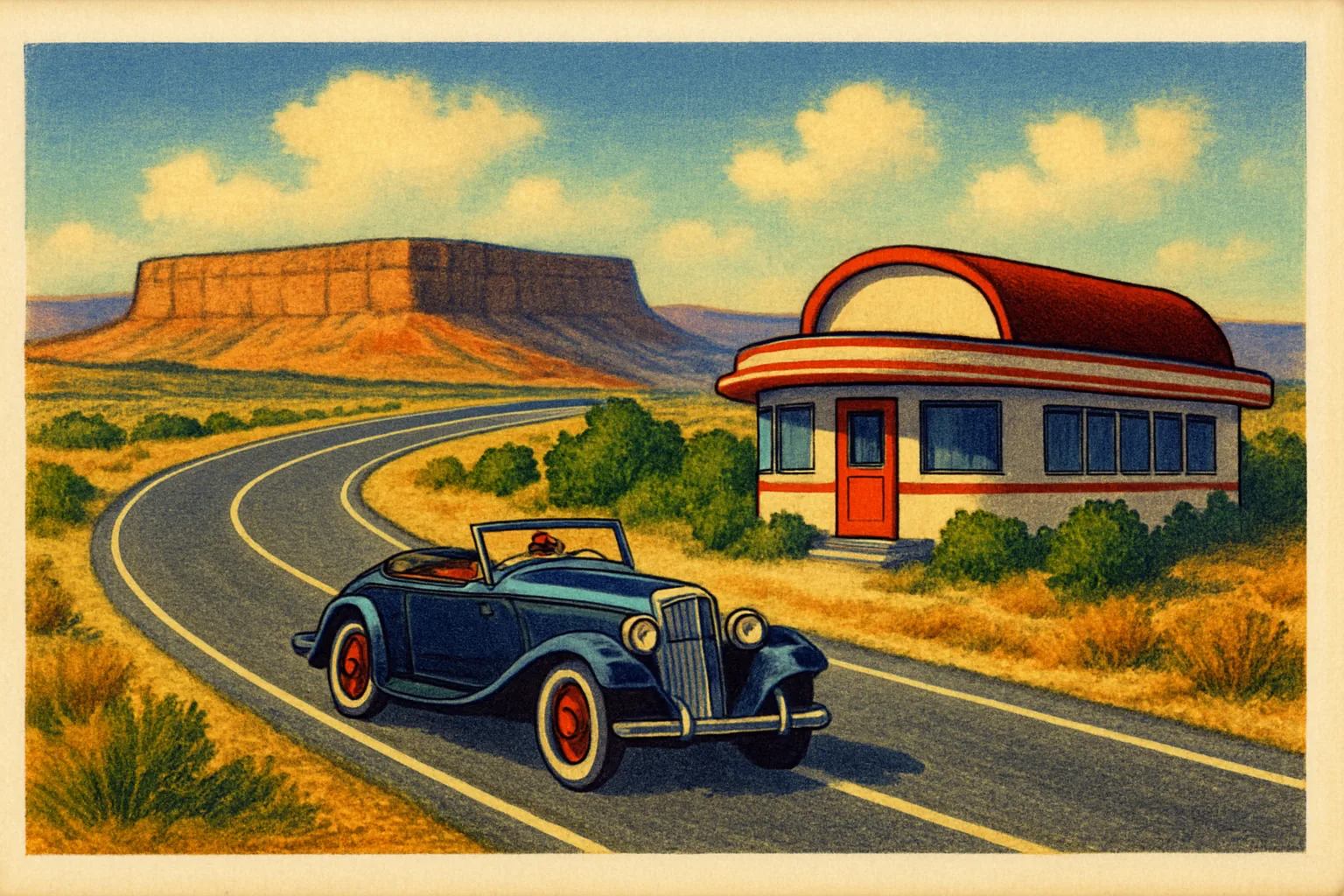
If the real photo postcard is the portrait of the small American town, the linen postcard is the portrait of the American road. From the early 1930s into the early 1950s, these textured, brightly colored cards showed the places travelers stopped along the way: tourist courts and motor lodges, filling stations, diners, roadside curiosities and the long ribbon of highway itself.
They were sold by the millions in racks at the very businesses they pictured, and mailed home by people who wanted to tell someone where they had gotten to. Read today, they are one of the best visual records of how Americans traveled in the years between the Depression and the interstates.
What makes a linen a linen
A linen card is printed on stock embossed with a fine, cross-hatched texture that looks and feels like woven cloth. Run your fingertip across the front and you can feel it. The texture let printers lay down heavy, saturated inks that dried quickly, which made bright color affordable for ordinary view cards.
The look is unmistakable once you know it: skies of intense blue, lawns of improbable green, neon signs glowing even in daylight scenes, and cars and people that look more painted than photographed. That is because they largely were. Linen cards started from photographs, but artists retouched them heavily, removing clutter, adding color, brightening signs and sometimes adding cars, people or landscaping that were never there.
I go into the physical details, including how to tell a linen from the chrome cards that followed it, in my guide to linen postcards.
Curt Teich and the Chicago presses
The name most associated with linen postcards is Curt Teich. Born in Greiz, Germany, in 1877, he came to the United States in 1895 and founded Curt Teich & Company in Chicago in 1898. By the 1930s his firm was one of the largest postcard printers in the country.
Teich's company introduced its linen-textured cards in the early 1930s, generally dated to 1931, under the trade name "Art-Colortone." Other publishers soon produced their own linen-style cards, among them Tichnor Brothers of Boston and E.C. Kropp of Milwaukee, but Teich's output was enormous and his name is on a large share of the linens you will find.
Teich was already a major printer before linens. One of my own cards, a white border view of Retreat Tower in Brattleboro, Vermont, published by Chas. W. Hughes of Mechanicville, New York, carries the line "C.T. American Art" and the number A-42474. That card dates from about 1913 to 1920, well before the linen era, and it is a reminder that the firm built its business on ordinary view cards long before the bright linens made it famous.
The Teich archive
When the company closed in 1978, its production records survived. The archive went first to the Lake County Discovery Museum in Illinois and later to the Newberry Library in Chicago, which opened it to researchers in 2017. According to the Newberry, it includes production materials for about 110,000 postcards, roughly from 1926 to 1960. Those files show how cards were made: the original photographs, the artists' instructions, and the color notes sent in by customers.
Teich production codes
Teich cards usually carry a production code on the back, a combination of numbers and letters. Collectors use these codes to date cards, because the code system changed over time in a way that encodes the year. For example, codes in the "9AH" series are associated with 1939. The details of the system take some study, and I don't want to oversimplify it here, but if you have a Teich linen, that code is the first thing to look up. It is often more precise than any other clue on the card, and it complements the methods in my guide on how to date an old postcard.
The roads that made the cards
Linen cards rode on a wave of road building and car ownership.
A national system of numbered highways
In 1926 the federal government and the states adopted a system of numbered United States highways, giving long-distance routes consistent names and markers. One of them was U.S. Route 66, designated in 1926 and running from Chicago to Southern California. Through the 1930s, stretches of these routes were paved and improved, and much of the work on Route 66 was finished with the help of Depression-era public works labor.
Better roads meant longer trips, and longer trips meant travelers needed places to sleep, eat and buy gasoline. A whole new landscape of roadside businesses grew up to serve them, and those businesses wanted postcards.
Route 66 on linens
Route 66 is the most famous of these highways, and it appears on many linen cards. Typical subjects include:
- Motor courts and cabin camps along the route in Missouri, Oklahoma, Texas, New Mexico and Arizona.
- Trading posts and curio shops selling souvenirs to travelers in the Southwest.
- Main streets of towns the highway passed through.
- Bridges, river crossings and scenic stretches of road.
Many cards don't say "Route 66" on the front at all, so the connection is in the address or the caption on the back: "on U.S. Highway 66," for instance. Those captions are worth reading closely.
The tourist court
The tourist court is the signature building of the linen era.
In the 1920s, motorists often camped by the road or in municipal campgrounds. Those campgrounds evolved into cabin camps, and then into tourist courts: rows or semicircles of small cabins, each with a parking space, often around a central office and a patch of lawn. Over time the cabins were joined into single buildings, and the "motor court" and later the "motel" took shape.
Owners commissioned postcards to advertise. A typical linen tourist court card shows:
- The cabins or units from a flattering angle, often with cars parked in front.
- A big sign with the court's name, sometimes in neon.
- A caption or back text listing amenities: "steam heat," "tile showers," "cafe in connection," "Simmons beds," "air cooled."
- An address, a highway number and sometimes a mileage to the next big town.
That back text is a small history of what travelers wanted. Hot water, private baths, heat in winter and cooling in summer were selling points worth printing.
Gas stations, diners and roadside attractions
Filling stations
Linen cards of gas stations show the canopies, pumps, signs and attendants of the period. Some are standalone station cards; others show a station as part of a combined business with a cafe and cabins. For anyone interested in the history of oil company branding or roadside architecture, these cards are a rich source.
Diners and cafes
Roadside eating places appear in great numbers. Diners in converted railcar shapes, cafes with counter seating, drive-ins and barbecue stands all ordered cards to hand to customers. Interior views, showing counters, stools, booths and the menu board, are especially interesting, since few photographs of ordinary restaurant interiors from the era survive otherwise.
Roadside attractions
To get travelers to stop, businesses built attractions: giant animals, odd-shaped buildings, reptile gardens, caves, snake pits, "mystery spots," wigwam-shaped cabins, and anything else that might catch a driver's eye. Linen cards of these places are among the most popular with collectors, because the attractions themselves were so eccentric, and many are long gone.
Large-letter cards
The best-known linen design is the large-letter card: a town or state name spelled in huge block letters, each letter filled with a small scene, over a banner reading "Greetings from."
Large-letter designs were not invented in the linen era. Teich is said to have brought the style to the American market after a visit to Germany in 1904, and earlier versions exist. But the linen process suited them perfectly, and in the 1930s and 1940s Teich and other printers produced large-letter cards for states, cities and small towns all over the country.
A few things make large-letter cards appealing to collect:
- Variety. Many towns had their own designs, and some had more than one.
- Small scenes inside the letters. These can show local landmarks, often taken from other cards in the same publisher's line.
- Bold graphic design. They are simply fun to look at.
Some large-letter cards are common; others, for smaller places, turn up much less often. As always, scarcity and condition both matter, a point I explain more fully in what makes a postcard valuable.
What the cards say about travel
Read a stack of linen cards from the 1930s and 1940s and some patterns emerge.
Travel by car was becoming normal
The sheer number of cards picturing roadside businesses tells you that ordinary families, not only the wealthy, were taking car trips. These were not grand hotels; they were modest places charging what a working family could pay.
Comfort was a selling point
The amenities listed on the backs of motor court cards show what travelers worried about: cleanliness, safety, private bathrooms, heat, cooling, good food nearby. The language reflects a public still a little uncertain about sleeping in roadside cabins.
The trip was the destination
Many cards celebrate the journey itself: scenic highways, bridges and mountain passes. Messages on the backs often report mileage, weather, road conditions and how far the family got that day.
The roadside was regional
Southwestern trading posts, Southern barbecue stands, Northern lake cabins and Florida citrus stands show how strongly local character shaped the roadside before chains standardized it.
The war changed things
During the Second World War, gasoline and tire rationing curtailed pleasure driving, and you will find linen cards from military bases and camps instead. After the war, travel boomed again, and the glossy photographic chrome card took over from the linen. By the early 1950s linens had largely given way.
Reading the backs
The backs of linen cards are full of information.
- The caption often gives the name of the business, its location, and a paragraph of description.
- The publisher's name and code help with dating.
- The postmark is the best evidence of when the card was actually used. Machine cancels of the period often include slogans, which can be fun in themselves. My guide on how to read a postmark covers what to look for.
- The message is often a travel report: where the writer stayed, what the weather was doing, how far they drove, and what they thought of the place.
Caring for linens
Linen cards are generally sturdy, but their textured surface can scuff, and their colors can fade with long exposure to light. Store them upright in archival sleeves, away from sunlight and damp, as described in my guide on how to store old postcards.
A road map in a shoebox
What I like most about linen cards is how much of the ordinary American landscape they preserve. Many of the tourist courts, filling stations, diners and roadside attractions they show are gone, replaced by interstates, chain motels and fast food. The cards may exaggerate the colors, but they record the shapes of buildings, the wording of signs, and the hopeful tone of small business owners inviting travelers to stop.
If you want to build a small collection around the highway, linens are a natural place to begin. They are widely available, and my post on starting a postcard collection on a budget has suggestions on picking a theme and finding cards without spending much. Pick a highway, a state or a kind of business, and you will soon have a road map in a shoebox.