If you have ever opened an old family album and found page after page of postcards, you have seen the leftovers of a national habit. In the years around 1905 to 1915, Americans mailed picture postcards the way people now send text messages: to say they had arrived, to report the weather, to show off a new building in town, or just to keep in touch. Collectors call this stretch the golden age of the postcard, and contemporary journalists had a name for it too: "postcarditis."
This post looks at why it happened when it did, how big it really was, and why it faded. None of it was an accident. A handful of postal rule changes, new delivery routes, cheap postage and a flood of beautifully printed cards all arrived at roughly the same moment.
How big was the craze?
The figure most often quoted comes from the Post Office's own count for the fiscal year that ended June 30, 1908. Sources repeat it as either 677,777,798 or 667,777,798 postcards mailed in the United States, which looks like a transcription slip somewhere along the line. Either way, the order of magnitude is the point: roughly two-thirds of a billion cards in a single year.
To put that in perspective, the 1910 census counted a little over 92 million Americans. Two-thirds of a billion cards means something like seven postcards for every man, woman and child in the country in one year, and that's only the cards that went through the mail. Many more were bought and tucked straight into albums without ever being posted.
I'm careful with totals beyond that one year, because I haven't found a reliable official figure for the whole craze. But if a country was mailing hundreds of millions of cards a year for most of a decade, the running total clearly reaches into the billions. That's where the title of this post comes from, and I'd rather give you the arithmetic than a made-up round number.
Reason one: the divided back
For the first few years of the century, the rules for private postcards reserved the entire back for the address. If you wanted to write a message, you had to squeeze it onto the front, around the picture. That's why so many undivided-back cards from 1901 to 1907 have handwriting crammed into the sky or along the bottom margin.
On March 1, 1907, the United States began allowing a message on the left half of the back, with the address on the right. Publishers drew a line down the middle, and suddenly a postcard was a proper little letter with a picture attached. You could write three or four lines without spoiling the view.
It's hard to overstate how much this mattered. The divided back made the postcard useful, not just decorative. It's also one of the most reliable dating clues on any card from the period, which is why it sits near the top of my guide on how to date an old postcard.
Reason two: mail came to the farm
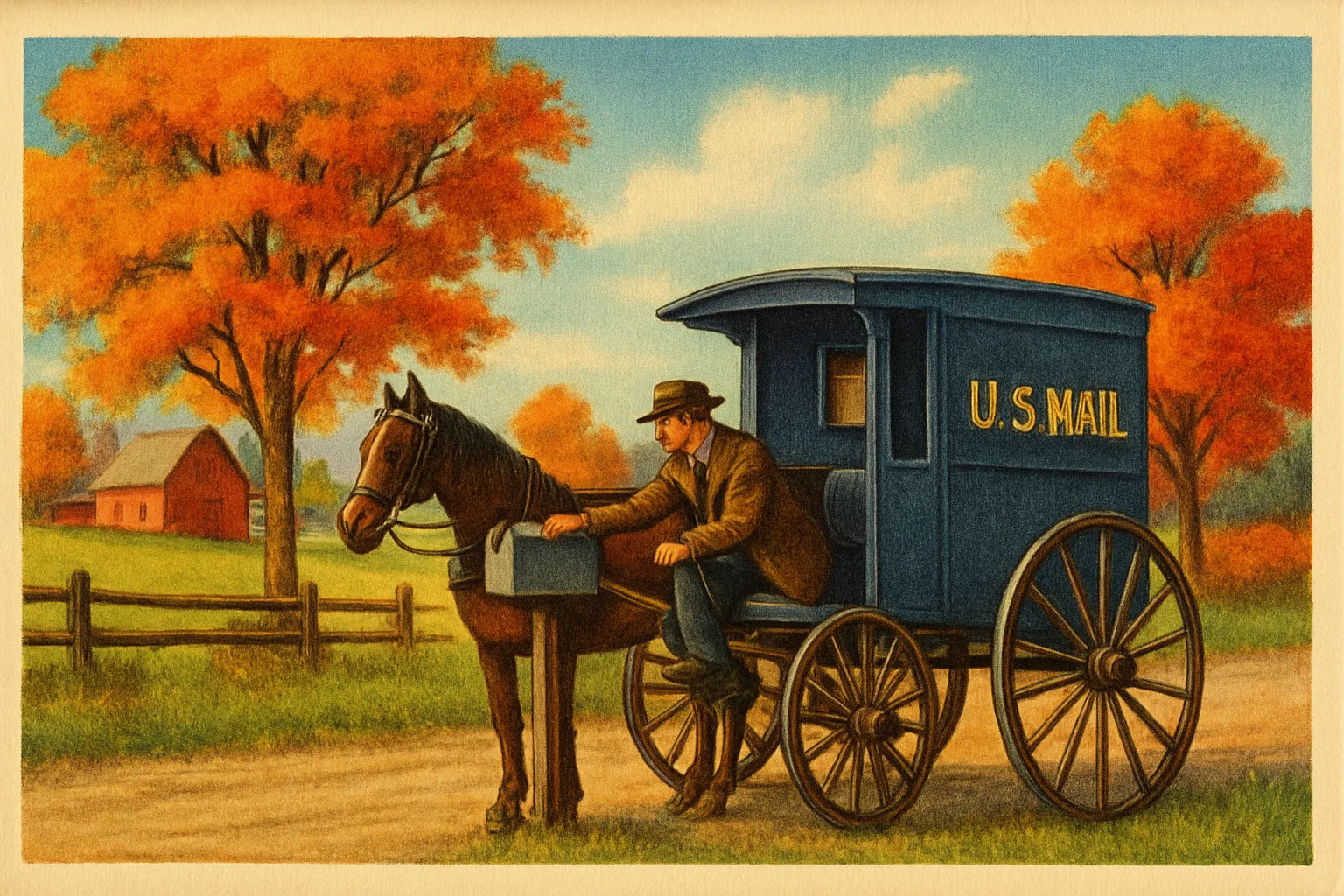
Rural Free Delivery is the part of the story that's easy to forget. Before it, most country people had to go to a post office in town to collect their mail, sometimes a long ride away. Rural delivery began as an experiment on October 1, 1896, on routes in West Virginia. It spread quickly, with thousands of petitions from rural Americans asking for routes, and it became a permanent service on July 1, 1902.
The timing lines up neatly with the postcard boom. A family on a farm in Kansas or Vermont could now receive cards at the end of the lane, and hand cards to the carrier to send. The postal service's own historians note that the fastest growth of rural delivery, in the first decade of the century, overlapped with the postcard craze. A huge new audience had been connected to the mail just as picture postcards became cheap and plentiful.
Reason three: it only cost a penny
Postage was the other half of the bargain. Under the Private Mailing Card Act of May 19, 1898, privately printed cards could travel at the one-cent rate starting July 1, 1898, the same as the government's own postal cards. Before that, a privately printed card with a picture on it generally had to pay the letter rate.
A penny for postage and a few cents for the card itself made the postcard the cheapest way to send a picture anywhere in the country. A letter cost two cents in those years, needed paper and an envelope, and seemed to call for more than a few lines. A postcard didn't. You could write "Arrived safe, weather fine, love to all," sign your initials and be done.
I've written more about how that one-cent rate shaped what people wrote in the penny postcard.
Reason four: German printing made them beautiful
The cards themselves were a big part of the appeal, and many of the best ones were printed in Germany. German lithographers had the skill, the equipment and the low costs to print rich, many-colored views and greetings in enormous runs. An American publisher, or even a small-town druggist, could send off a photograph of Main Street and get back boxes of handsome color cards printed abroad.
You can still see the evidence on the backs: "Printed in Germany," "Made in Germany," or a Saxon or Bavarian printer's mark. Embossed holiday greetings from this period, with their gold highlights and raised flowers, are some of the most elaborate pieces of printing ordinary people ever owned.
That dependence on imports is also part of why the craze cooled. In 1909 the Payne-Aldrich tariff raised duties on imported postcards. Accounts differ on exactly who lobbied for what, but importers rushed in huge stocks of German cards before the new duties took effect, which led to a glut and price-cutting. Then the First World War cut off the German supply altogether.
Reason five: everybody was collecting
People didn't only send postcards. They kept them. Postcard albums, with slotted pages or corner mounts, were sold everywhere, and an album full of cards from friends and relatives was a kind of social record. Some people traded cards by mail with strangers who shared the hobby. Women in particular were enthusiastic correspondents; one widely repeated observation from the period is that women sent and received far more cards than men.
Collecting fed sending, and sending fed collecting. If your cousin kept an album, you sent her a card of your town. If she sent you one back, it went in yours. Holidays added another layer. Christmas, Easter, Valentine's Day, Thanksgiving and Halloween cards were mailed in such volume that newspapers of the time wrote about local post offices struggling under the load. (If holiday cards are your interest, my guide to vintage Halloween postcards covers some of the most sought-after designs from these years.)
The album habit is why so many golden-age cards survive in good condition. They were mounted, closed up and put on a shelf. It's also why so many have small corner marks or slight damage where they were slipped into album slots.
Reason six: anyone could make one
Not every card came off a printing press. After Kodak began selling photographic paper with a postcard back printed on it, and then a camera made to take postcard-size negatives, photographers could turn any picture into a mailable card. Local studios and traveling photographers made real photo postcards of streets, schools, churches, floods and fires, often in very small numbers.
That meant even a tiny village could have its own postcards, and families could make cards of their own houses and children. I've written about the people who did this work in traveling real photo photographers, and the identification side is covered in my guide to real photo postcards.
What people actually wrote
Read enough golden-age postcards and you start to notice how much they resemble short messages today. A sample of the kinds of things people wrote:
- Arrival notices: got here safely, train was late, the hotel is fine.
- Weather reports, constantly. Rain, snow, heat, a late spring.
- Health news: feeling better, the baby has a cold, back from the doctor.
- Plans: coming Thursday, meet the noon train, will write a letter soon.
- Small jokes and teasing between friends and sweethearts.
- Notes on the picture itself: an X marking the writer's hotel room, or "this is where I work."
Very little of it is profound, and that's exactly what makes it valuable now. These cards are a record of everyday life written by ordinary people in their own words. For family historians, a single card can place an ancestor in a particular town on a particular day.
Why the craze faded
Several things happened at once in the 1910s, and historians weigh them differently.
- The tariff and the war. Higher duties in 1909, and then the loss of German printing from 1914, made good cards scarcer and plainer. American printers filled the gap, but the early wartime cards are often less lavish, and the white border style that followed saved ink.
- The novelty wore off. Every craze peaks. By around 1910 to 1915, sending picture postcards was no longer new and exciting.
- Greeting cards in envelopes. Folded greeting cards, sent in envelopes, increasingly replaced postcards for holidays.
- The telephone. For quick messages within a town, a phone call was faster than any card.
- Wartime postage. From November 2, 1917, to July 1, 1919, the postcard rate doubled to two cents as a war revenue measure, which took a little more shine off the penny bargain.
Postcards never went away, of course. They settled into a steadier role as travel souvenirs, and later eras produced their own distinctive styles, from the linen postcards of the highway age to glossy chromes. But the sheer everyday volume of the golden age was never repeated.
What the craze means for collectors today
The scale of the golden age has a practical consequence: a great many cards from 1905 to 1915 survive, and plenty of common views and greetings remain inexpensive. A printed card of a big-city landmark was made in huge numbers, and you can still find it easily.
At the same time, the craze reached into places that never got much attention before or since. Small towns, crossroads villages, rural schools and local businesses all appeared on cards, sometimes only once. Those are the cards that collectors and local historians chase, and the reasons are explained in my guide to what makes a postcard valuable.
A few things to look for when you pick up a card from this period:
- The back. A divided back with a full-bleed picture and no white border usually points to about 1907 to 1915.
- The printer. "Printed in Germany" is common on cards from before the war.
- The stamp and postmark. A one-cent stamp and a clear town postmark tell you when and where the card traveled. My guide on how to read a postmark walks through the details.
- The message. Names, places and dates can connect a card to real people and local history.
A national conversation on cardboard
What strikes me most, handling these cards, is how democratic the whole thing was. A penny stamp, a card bought for a few cents at the drugstore, and a pencil were all anyone needed. Farm families on new rural routes, factory workers, schoolteachers, summer visitors and children all joined in. The result is a vast, scattered record of how Americans saw their own towns and talked to each other in the years before the First World War.
Each card that survives is one small piece of that conversation. When I sort a stack of them, I try to remember that every one was chosen by somebody, written by somebody and carried by a mail carrier to somebody's door. That's a lot of history for a piece of cardboard three and a half by five and a half inches.
If you'd like to see some of the cards I'm currently researching and listing, there's more about how I work on my about page, and the where to buy page explains where my cards are available.