Most old postcards that went through the mail carry a postmark, and that mark is often the most precise date on the card. It also tells you where the card started its journey, sometimes where it ended, and occasionally something about the post office itself. Some postmarks interest postal historians more than the picture on the front.
This guide explains the parts of a postmark, the main kinds of cancel you'll see on American postcards from the early 1900s through the mid-century, how to read one that's faint or partial, and how postmarks fit into dating a card.
Postmark or cancel?
People use the two words loosely, and so do most dealers, but they mean different things.
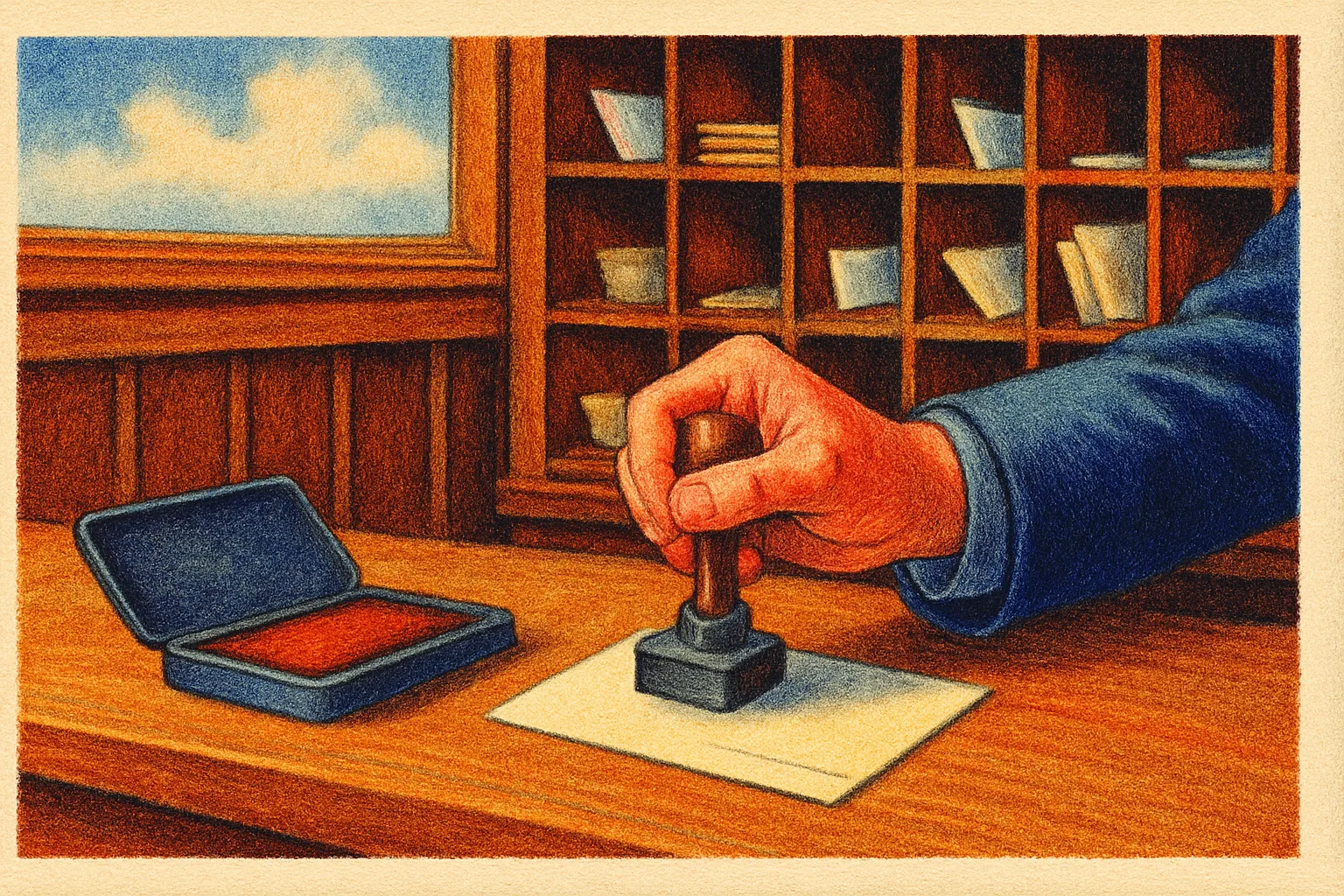
- The postmark is the part that records the place and date of mailing. On most American cards it's a circle, sometimes called a circular date stamp or CDS, with the town and state around the edge and the date in the middle.
- The cancel is the part that defaces the stamp so it can't be used again. Collectors often call it the killer or the obliterator. It might be a set of bars, wavy lines, a flag, a cork design or a smear of ink.
On most cards from the period, the two were struck together from one device, so the postmark sits to the left and the killer lands on the stamp. When I write "postmark" in my listings, I mean the whole mark, but it helps to know which part is which.
The parts of a postmark
A typical early twentieth-century postmark has some or all of these:
- Town name, around the top of the circle.
- State, usually abbreviated, around the bottom. Before standard two-letter abbreviations, states were written in many forms: "Mass.," "Penn.," "Pa.," "Wis.," "Cal.," "Colo." and so on.
- Month and day, in the center, often in a form like "OCT 31."
- Year, either in the center below the date, or as two digits, like "08" for 1908.
- Time, on many city and machine postmarks, written as an hour with "AM" or "PM," or sometimes just a number. Small-town hand stamps often skip the time.
- Killer, to the right: bars, lines, a flag or a number.
- Station or branch, on cards mailed in big cities, sometimes added as "Sta. A" or a station name.
Later postmarks may include a postal zone number for a big city, from 1943, or a ZIP code, from 1963. Either one is a useful dating clue.
The main types of cancel
Hand stamps
At the thousands of small post offices across the country, the postmaster struck each piece of mail by hand. Hand cancels vary enormously. Some are crisp, many are smudged, and some offices used inks other than black, such as purple or blue. Early hand stamps sometimes had a separate killer struck alongside, or a killer of any design the postmaster had on hand, such as a cork carved into a star or a target.
At the very smallest offices, especially in the nineteenth century, postmasters sometimes wrote the town and date by hand, a manuscript cancel. These are much less common on twentieth-century postcards, but they do turn up.
Duplex cancels
A duplex handstamp joined the postmark and the killer on a single device, so one strike did both jobs. The postmark circle prints on the left and the killer, often an oval of bars with a number or letter in the middle, prints on the right, over the stamp. Duplex cancels were widely used in larger offices in the late 1800s and early 1900s.
Doane cancels
From early 1903, the Post Office Department began issuing standardized hand cancels to fourth-class post offices, the smallest category. Collectors call these Doane cancels, after Edith Doane, a collector who studied them. A Doane cancel is a circular postmark with a set of bars to the right, and a number inside the bars.
That number wasn't random. It reflected the postmaster's compensation, which was based on the office's revenue, so a "1" usually meant a very small office. Collectors divide Doanes into three main types, issued between 1903 and about 1906, which differ in the number and style of the bars and the lettering.
A Doane is a nice thing to find on a card, especially from a small or long-closed office. Reference lists of known Doane cancels by state exist, compiled by collectors, and they can tell you whether a given office is known to have used one.
Four-bar cancels
After the Doanes, the Post Office supplied small offices with four-bar cancels: a circular postmark with four horizontal bars to the right, without a number. Four-bar cancels became the standard hand cancel of the small American post office for much of the twentieth century. Collectors who specialize in them distinguish several styles by the spacing of the bars and the lettering, which changed over the decades. Some styles look a good deal like Doane cancels, so check a reference before calling a card a Doane.
Machine cancels
In busy city post offices, mail was cancelled by machine. The machines fed letters and cards past a rotating die that printed the postmark and the killer in one pass. Early machines were tested in Boston in the 1880s and spread through the country's larger offices over the following decades. Several companies made them, and their cancels look different.
Machine cancels on postcards usually have a circular postmark, often with the time, followed by a killer of:
- Wavy lines, the most familiar kind, still in use today.
- Straight bars, in groups.
- Flags. A waving American flag as the killer, used on several types of machine.
- Slogans and pictures, which came later, advertising events, causes or postal services.
Because the dies were fixed, machine postmarks are usually more even and easier to read than hand stamps, though they often strike across the picture side of the card or across the message when the card went through the machine at an angle.
Flag cancels
Collectors give flag cancels special attention. The first machine flag cancel was used in Boston at the end of 1894, and flag killers were used by many city post offices in the late 1890s and early 1900s. There are many varieties, which differ in the flag's design, the number of stripes, and the wording or numbers in the postmark. Flag cancel specialists track them by city and date.
Other markings you may see
Receiving marks
On many early 1900s cards, a second postmark was added at the destination post office. This receiving mark, sometimes called a backstamp, records when the card arrived. On a postcard, it's often found on the picture side or in the message area, since there was no envelope back to strike. Receiving marks are useful because they show how long the card took to travel, and they prove the card reached the town it was addressed to. They're common on cards from the early 1900s and less common later.
Transit and railway post office marks
Some cards picked up marks from railway post offices, the mail cars on passenger trains where clerks sorted mail en route. These marks usually name the two ends of the route, like "Chicago & Omaha," and sometimes a train number. Railway post office markings are a collecting field of their own.
RFD
Rural Free Delivery began as an experiment on October 1, 1896, around Charles Town, Halltown and Uvilla, West Virginia, and became a permanent service on July 1, 1902. Rural carriers brought mail to the mailboxes of farm families and collected outgoing mail, which was generally taken back to the post office and postmarked there. So on most cards, RFD shows up in the address, as "R.F.D. No. 2" or "Route 3," rather than in the postmark. Those addresses are a small piece of history: they show the moment when rural families no longer had to go to town for their mail.
Postage due, forwarding and missent marks
Short-paid mail got "Postage Due" markings, sometimes with a due stamp attached. Cards that were readdressed or forwarded may show a second address and a second postmark. Cards sent to the wrong office sometimes carry a "Missent" handstamp. Each tells a small story about the card's trip.
Discontinued post offices
The number of American post offices peaked at 76,945 in 1901, according to the Postal Service's own history. As Rural Free Delivery spread and roads improved, thousands of small offices closed, and towns shrank or disappeared. A postmark from an office that no longer exists is called a DPO (discontinued post office) postmark.
DPOs matter to postal history collectors because the office often operated for only a few years, and surviving postmarks may be few. A card that looks ordinary from the front can be interesting because of the small town on its back. Collectors use published lists of post offices by state, with their opening and closing dates, to identify DPOs and to check whether a postmark falls within an office's known years.
How to read a faint or partial postmark
Many postmarks are light, smeared or struck half off the card. A few techniques help.
- Use good light at a low angle. Light coming across the card from the side shows the slight impression left by the handstamp, even where the ink is thin.
- Magnify. A loupe or a phone camera zoomed in makes a big difference. Photograph the postmark and enlarge the photo.
- Adjust the image. Raising the contrast on a photo or scan, or switching to grayscale, can make faint ink stand out. Inverting the colors sometimes helps too.
- Read the letters you're sure of first. If you can read "...LEBORO" and "VT," the town isn't hard to work out. For the date, a year often survives even when the month doesn't.
- Use the circle. Town names are spaced evenly around the top of the circle. Counting the gaps where letters should be gives you the length of the missing name, which narrows the candidates.
- Check the address and message. The writer may mention the town, the day or the season. The address may be to a nearby town, which helps you guess where the card was mailed.
- Compare. A list of post offices in a state, or a postal history society's records, can confirm whether a candidate town existed and had a post office at that date.
- Know when to stop. If you can't read it, say so. "Postmark illegible" is honest. A guess presented as fact is not.
When I can only read part of a postmark, I list what I can read and mark the rest as uncertain.
What a postmark tells you about dating
The postmark date is the date the card was mailed. That's the latest possible date for the card's printing, but it isn't the printing date. Cards could sit in a shop rack for years, or in a drawer, before someone mailed them. A card printed in 1908 and mailed in 1923 isn't unusual.
So I use the postmark as the end of a range, and combine it with the other clues: the back design, the publisher's code, the stamp box on a real photo, and the postage rate. My guide to dating old postcards walks through those clues in order. Two examples show how the postmark fits in.
- A divided-back card with a 1910 postmark was printed between March 1907 and 1910.
- A linen with a Teich code for 1941 and a 1946 postmark was printed in 1941 and mailed five years later. The guide to linen postcards explains how to read those codes.
The postmark also checks the stamp. A one-cent stamp on a domestic card from 1918 would have been short-paid, since the wartime rate from November 1917 to July 1919 was two cents, so you'd expect a due marking, an extra stamp or a sender who was never caught.
What postmarks add to a card's interest
For most collectors, a postmark is a nice extra rather than the main attraction. But a few kinds draw particular interest:
- Small-town and DPO postmarks, especially on a card showing the same town.
- Doane cancels, especially from rare offices.
- Flag cancels of scarce types or cities.
- Railway post office marks.
- Expositions and events, where a special postmark was used at a world's fair or celebration.
- Early dates, such as a card mailed in the very first days of a new postal rule.
A real photo of a small town with that town's own postmark on the back is a particularly satisfying combination. My guide to real photo postcards explains why those cards are so prized, and my guide to what makes a postcard valuable covers the broader picture, including why a postmark alone rarely makes an ordinary card valuable.
Caring for postmarked cards
Never try to "clean up" a postmark. Erasers, solvents and water damage the card and remove history. Don't soak stamps off old postcards either, as a stamp on its original card with a clear postmark is generally more interesting to collectors than a loose stamp. Store postmarked cards like any other, in archival sleeves away from light and damp. My guide to storing old postcards has the details.
Questions people ask about postmarks
Why is the postmark on the front of my card? Some machines and clerks struck wherever they could, and on early undivided-back cards the stamp was sometimes placed on the front. Receiving marks also often landed on the picture side.
Why does the postmark town differ from the town in the picture? Travelers bought cards in one place and mailed them later, and people mailed cards of nearby towns from their own post office. The mismatch is normal.
What does the number in the killer bars mean? On a Doane cancel, it relates to the postmaster's compensation class. On a duplex or machine cancel, a number in the killer often identified the clerk, machine or station.
Is a card worth more if it's postmarked? It depends on the collector. Some prefer unused cards for a clean back. Others like a clear postmark and message. Except for particular postal history items, a postmark rarely changes a card's value much either way.
Where to go from here
Postmarks are a small window into how mail moved a century ago. Every card I list has its postmark read as far as it can be, with the town, the date and anything unusual noted. Browse my where to buy page to see them, and the rest of my collector's notes for more on dating and identifying old cards.