One of the most common questions about old postcards is some version of "Is this worth anything?" It's a fair question, and the honest answer is that most old postcards are worth a few dollars, many are worth less, and a small number are worth a great deal more. The difference between them usually has little to do with age, and a lot to do with what the card shows, how many copies survive and who wants it.
This guide explains the factors that drive postcard value, the myths that mislead people, and how to think about a card or a collection you have in front of you. It doesn't give prices for particular cards. Prices change, and the only reliable guide to a card's value is what comparable cards have actually sold for recently.
Why most postcards aren't rare
Postcards were a mass medium. In the years after the divided back was allowed in 1907, Americans mailed postcards by the hundreds of millions each year, and many households kept them in albums. Popular views of landmarks, resorts, big cities and scenery were printed in huge runs, often many times over.
Many of those cards survived. That means the typical card that turns up in a family box, a view of a state capitol, a scenic lake, a big-city hotel, a common greeting, has thousands of surviving siblings. Supply is large, and demand for that particular card is modest. That's why so many cards sell for small amounts, however old they are.
That's not a bad thing. It means a collector can build a wonderful collection of early cards without spending much, and it means the cards that really are scarce stand out.
The factors that matter
Scarcity
Scarcity is the foundation of value. A card that was printed in small numbers, or that rarely survived, is harder to find, and if anyone wants it, it commands a higher price.
Some of the scarcest cards are:
- Small-town views, especially of towns that were small then and are smaller now. A small-town drugstore might have ordered a single run of a few hundred cards, and a traveling photographer might have printed only a few dozen real photos of a main street.
- Real photo postcards of specific places, people and events, which were often made in very small numbers. My guide to real photo postcards explains why.
- Cards of short-lived businesses, buildings and events.
- Cards from small publishers and local photographers.
Scarcity alone isn't enough, though. A card can be very scarce and still find few buyers if nobody collects that subject.
Subject
What the card shows usually matters more than anything else. Collectors and historians pay most for cards that document something specific and hard to see any other way.
Subjects that draw strong interest include:
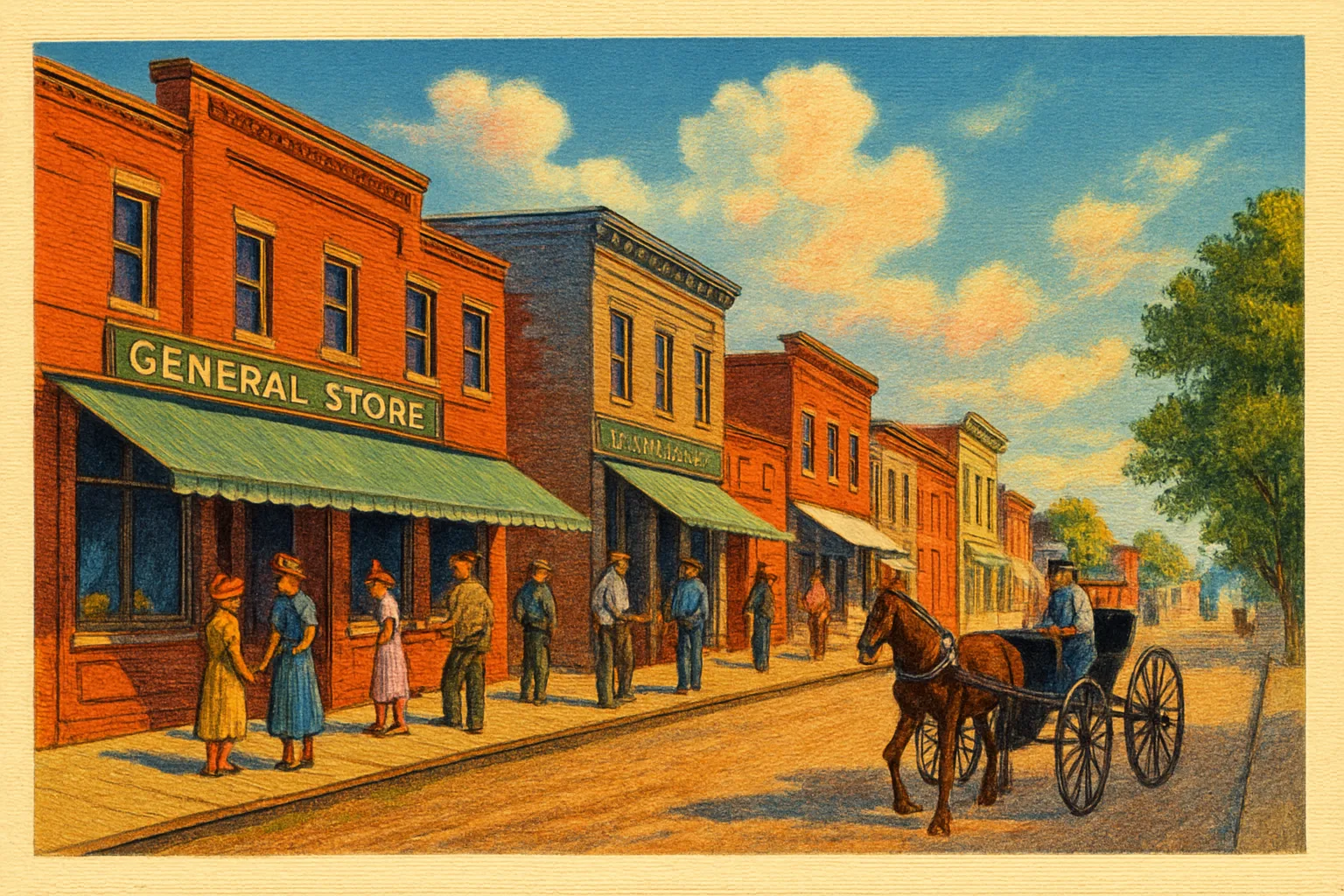
- Street scenes with life. Main streets with people, wagons, early cars and readable shop signs.
- Interiors. Inside a general store, barber shop, saloon, bank, post office, drugstore, diner or factory, with the people and goods.
- Businesses. A storefront with its name on the sign, a gas station, a mill, a creamery.
- Transportation. Railroad depots with a train in the station, trolleys, interurbans, early automobiles, airplanes, steamboats and ferries.
- Events. Floods, fires, train wrecks, parades, fairs, political rallies, circus arrivals.
- Occupations. People at work: loggers, miners, farm crews, mill workers, fishermen.
- Social history. Images that record the lives of particular communities, sports teams, schools and organizations.
- Advertising. Cards issued by companies to promote their products.
By contrast, scenic views, famous landmarks, unidentified studio portraits and common greetings are usually inexpensive.
Publisher and artist
Some publishers and artists have devoted followings. Early chromolithographed cards by Raphael Tuck & Sons, Detroit Publishing Company views, Halloween cards from John Winsch, and cards signed by well-known illustrators all draw dedicated collectors. My guides to vintage Halloween postcards and artist-signed postcards cover some of those names.
A famous name doesn't guarantee value, though. Big publishers printed a lot of cards, and many of their common designs remain common. Within a publisher's output, the subject and the design still decide most of the difference.
Era
The era of a card affects its appeal more than its value. Collectors tend to associate the golden age of about 1907 to 1915 with the finest printing, and early cards, from before 1907, can be harder to find. But a 1950s chrome of a small-town diner may be far more wanted than a 1908 view of a famous building. Era is a clue about scarcity and printing quality, not a value in itself.
My guide to dating old postcards explains how to place a card in its era.
Condition
Within the same card, condition makes a large difference. A clean, sharp card with crisp corners, strong color, no creases and no album damage is worth more than a worn copy of the same view, sometimes far more.
Common condition problems include:
- Corner wear, the most common flaw.
- Creases, which break the surface and are more serious than bends.
- Album marks, from old albums.
- Toning and foxing, overall yellowing and small brown spots.
- Stains, tears and pinholes.
- Trimming, which reduces value significantly.
- Fading, especially on photographs and linens.
- Writing on the front, which bothers some collectors more than others.
For a scarce card, condition matters less. Collectors will often accept a worn copy of a view they've never seen before, because there may not be a better one. For a common card, condition is almost everything, because a better copy is always available.
Good storage protects condition, and it's never too late to start. My guide to storing old postcards explains how.
Eye appeal
Two cards of the same view in the same condition can still differ because one is simply a better picture: sharper, better composed, with more happening in it. Collectors respond to strong images. A real photo with excellent contrast and clear detail, or a beautifully printed lithograph with rich color, is easier to sell and generally commands more than a dull or muddy one.
Demand
Value is ultimately set by how many people want a card. Some places and subjects have many collectors: certain states and cities, railroads, Route 66, lighthouses, Halloween, early automobiles. Others have few. A card of a small town with an active historical society and many former residents may find more interested buyers than a similar card from a town nobody collects.
Demand also changes over time. Subjects go in and out of fashion, and prices follow.
Common myths
"It's over a hundred years old, so it must be valuable."
Age is the most common misunderstanding. Billions of postcards were printed in the early twentieth century, and many survive. A century-old card is an interesting object, but age alone doesn't make it scarce or wanted.
"The listing says rare."
The word "rare" in an online listing tells you about the seller's hopes, not about the card. Some sellers use it on every listing. A truly scarce card is scarce because few copies are known, and the only way to judge that is to look at what turns up and what sells.
"Asking prices tell you what a card is worth."
What sellers ask and what buyers pay are different things. A card can sit at a high asking price for years without selling. Completed sales, the prices that cards actually sold for, are the useful guide.
"The postmark makes it valuable."
For most cards, a postmark adds little. It's a pleasant detail and a useful dating clue. A few postmarks interest postal history collectors, especially those from discontinued post offices, some Doane cancels and certain special or early markings, and in those cases the back can matter. But an ordinary postmark on an ordinary card doesn't change its value much. My guide to reading postmarks explains which kinds draw interest.
"The stamp must be worth something."
The one-cent and two-cent stamps on most old postcards were printed in enormous numbers and are very common. Occasionally a stamp or its usage is of interest to stamp collectors, but most are not, and a stamp on its original card is usually more interesting than a loose one.
"A whole album is worth more than the cards in it."
Sometimes an intact album has historical interest as a set, especially if it documents one family or one place. But most often, collectors buy the cards they want, and an album of mostly common cards is valued by its best few.
"Reproductions are just as good."
Modern reproductions of popular postcards exist, and a copy isn't a vintage card. Learn the signs: dot patterns under magnification, modern card stock, a 4 by 6 inch size, and a modern publisher or website on the back.
A few simple tests for your own cards
If you have a box of cards and want a rough sense of what's in it, a few quick sorts help.
- Pull out the real photos. Use a magnifier: no dot pattern, a photographic surface, and often a paper maker's name in the stamp box.
- Pull out anything showing people, businesses, interiors, events or transportation.
- Pull out small towns. Especially places you've never heard of.
- Look for famous publishers and signed cards.
- Set aside scenic views, landmarks, big cities and common greetings. These are usually the inexpensive cards.
- Check condition on the cards in the first piles.
The cards that end up in the first few piles, in good condition, are the ones worth a closer look.
How to research a card's value
- Look at completed sales. Search for cards of the same town, publisher and subject, and filter for sold listings rather than active ones. Look for close matches, not just similar subjects.
- Compare condition. Adjust your expectations for any differences.
- Check with local historical societies or collectors of the place. They can tell you whether a view is commonly seen.
- Visit a postcard show. Dealers specialize by state and subject, and seeing a few hundred cards of your topic in one afternoon teaches a lot.
- Read reference books on particular publishers or artists.
Be wary of anyone who gives you a value without seeing both sides of a card, and of any figure that isn't based on actual sales.
Why a few cards are worth much more
Put all of these factors together and the pattern is clear. The cards that are worth far more than the rest usually have several things going for them at once:
- A specific, documentary subject, like a store interior or a train wreck,
- in a small or historically interesting place,
- made in small numbers, often as a real photo,
- with a sharp, well-composed image,
- in good condition,
- in a subject or place that many people collect.
A card with only one of those qualities is usually still a modest card. A card with four or five of them can be something special.
How I price my own cards
When I list cards, scarce cards get individual attention: I look at what comparable cards have actually sold for, adjust for condition, and set a fair price. Common cards are priced simply, by type and condition, and many are offered in lots. You can read more about that on my about page, and see what I have now on my where to buy page.
I don't appraise cards for people who aren't selling, but the factors above, and the rest of my collector's notes, will help you understand what you have. If you're thinking of selling, I buy collections of every size and I'll tell you honestly what I see.
Questions people ask about postcard value
Are unused cards worth more than used ones? Not as a rule. Some collectors prefer unused cards for their clean backs. Others prefer used cards with a postmark and a message. For most cards, it makes little difference. For a few postal history items, the postmark is the whole point.
Does writing on the back hurt value? Rarely. Messages on the back are expected, and many collectors enjoy them. Writing on the front, across the picture, is more likely to reduce value.
Are foreign cards worth less? Not necessarily. Demand follows collectors, and many countries have active collecting communities. A scarce view from anywhere can be valuable to the right buyer.
Should I sell a collection as a whole or card by card? That depends on the collection and how much time you have. A collection with a few strong cards and many common ones is often handled by setting the best cards aside and selling the rest in groups.