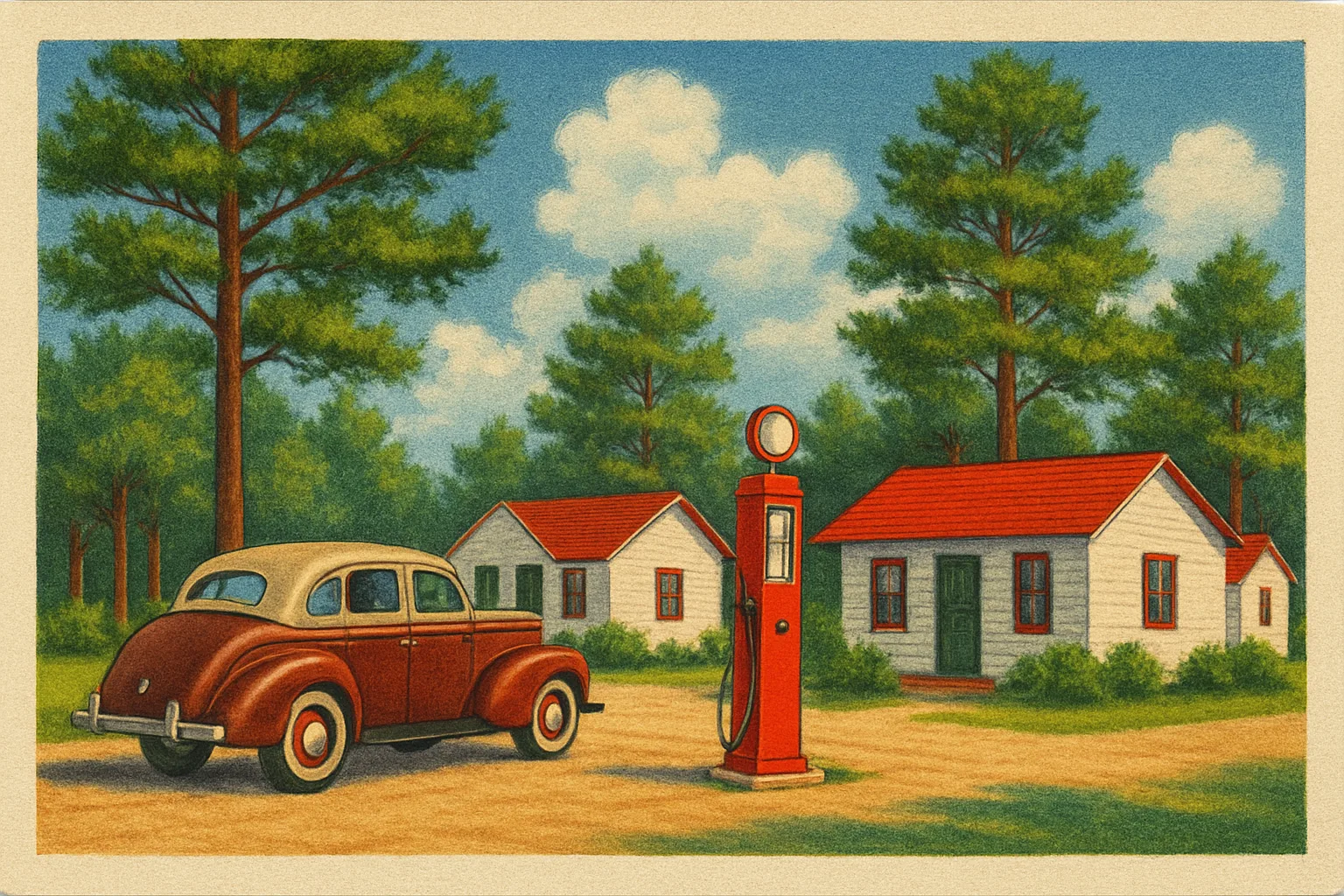
If you've ever seen a postcard of a roadside diner glowing in impossible colors, or a "Greetings from" card with a state name spelled out in giant block letters, you've seen a linen. These cards dominated American view cards from the early 1930s into the early 1950s, and they're easy to recognize once you know what to feel for.
This guide explains what a linen postcard is, who printed them, what they show, how to tell them from the cards that came before and after, and how to date them, sometimes to the exact year.
What a linen postcard is
A linen postcard isn't made of cloth. The name comes from the card stock, which was embossed with a fine crosshatched texture that looks and feels like woven linen. The texture had a practical purpose. Card stock with a high rag content and a textured surface could take a lot of ink and dry quickly, which let printers run bright, saturated colors at high speed and low cost.
The front image usually started as a black-and-white photograph. Artists at the printing company retouched it heavily, removing wires and clutter, adding blue skies and puffy clouds, brightening signs, and sometimes inventing details altogether. Colors were then laid down in several passes. The result is a picture that looks part photograph and part painting, with strong reds, yellows and blues that no real street ever had.
How long the linen era lasted
Curt Teich & Co. of Chicago introduced its linen-finish "Art Colortone" cards around 1931, and other printers soon followed. Linens were the dominant style of American view card through the 1930s and 1940s. By the late 1940s, glossy photochrome cards, made from color photographs, were taking over, and by the early 1950s the linen era was largely over, although some linens were still printed into the 1950s.
How to identify a linen
You can usually identify a linen in a few seconds, by touch and by eye.
- Feel the front. Run a fingertip across the image. A linen has a fine, regular texture, like very fine fabric or canvas. Tilt the card under a light and you'll see the crosshatch pattern.
- Look at the colors. Linens are bright and saturated, often with a slightly flat, poster-like quality. Skies tend to be bright blue, and signs and cars pop.
- Look for the white border. Many linens have a white border around the image, though not all.
- Check the back. Most linens have a divided back with a printed caption or description, the publisher's name, and often a code number. The back is usually smooth, without the front's texture.
- Check the size. Linens are the standard size, about 3.5 by 5.5 inches.
How a linen differs from what came before and after
| Style | Approximate dates | How it looks and feels |
|---|---|---|
| White border | about 1915 to 1930 | Smooth stock, white frame around the image, often muted color |
| Linen | about 1931 to the early 1950s | Fine woven texture on the front, bright saturated inks, retouched images |
| Photochrome ("chrome") | 1939 onward, common from the late 1940s | Glossy, smooth surface, made from color photographs, realistic color |
The dates overlap at the edges. Printers used up stock, and some publishers kept older styles in print. My guide to dating old postcards explains how all the eras fit together.
The printers behind the linens
A few large printers produced most American linens. Many cards were printed for a local distributor or merchant, whose name appears on the back, but the printer's name or trademark is usually there too, often in small type.
Curt Teich & Co., Chicago
Curt Teich, a German-born printer, built one of the largest postcard printing businesses in the world in Chicago. Teich pioneered the linen card, marketed as "C.T. Art-Colortone," and printed linens of towns large and small in every state. Teich cards are the most common linens you'll find, and the best documented, thanks to the company's numbering system and its surviving archive. The Curt Teich Postcard Archives are now held by the Newberry Library in Chicago.
Tichnor Brothers, Boston
Tichnor Brothers printed a large number of linens, especially of New England and popular vacation destinations, under the label "Tichnor Quality Views." The Boston Public Library holds a large collection of Tichnor office proofs from roughly the 1930s and 1940s. Tichnor later sold glossy cards under the name "Lusterchrome."
E. C. Kropp Co., Milwaukee
Kropp was an old firm by the linen era. It had been publishing postcards since the late 1890s, and it printed linens of towns and attractions across the country, particularly in the Midwest and West. The company was sold off in the mid-1950s.
Asheville Post Card Co., Asheville, North Carolina
Founded by Lamar LeCompte in Asheville in 1913, this company sold cards through traveling salesmen who called on hotels, drugstores and tourist attractions. Its linens cover much of the South and the Appalachian tourist country, and its cards are popular with collectors of the region.
Colourpicture, Boston and Cambridge
Colourpicture Publishers operated from the late 1930s, printing linens and later moving into glossy cards under the "Plastichrome" name in the 1950s.
Others
You'll also see linens from smaller printers, such as MWM of Aurora, Missouri, and from many local news companies, drugstores and novelty firms that sold cards printed for them by one of the big houses. When the printer isn't obvious, look closely at the stamp box and the small print along the edges.
What linens show: roadside America
The linen era coincided with a huge change in American travel. Car ownership spread, paved highways reached small towns, and families started taking driving vacations. Businesses along the road needed advertising, and a postcard was cheap and portable. Linens captured all of it.
- Motor courts, tourist cabins and motels. Often printed for the business itself, with the address and a short description on the back.
- Diners, cafes and roadside stands. Including the famous novelty buildings shaped like coffee pots, hot dogs and other unlikely things.
- Gas stations and garages. Often with period cars and pumps in the foreground.
- Main streets. Small-town business districts in bright color, with signs you can often read.
- Highways and bridges. Route 66 and other famous highways are especially popular collecting themes.
- Attractions. Caves, springs, alligator farms, reptile gardens, observation towers and roadside museums.
- Hotels and resorts. Many with interior views of lobbies and dining rooms.
- Military and wartime cards. Army camps, training bases and comic military cards from the Second World War years.
- Comics. Humorous cards, many with mild bathing-beauty, hillbilly or fishing jokes.
Because the images were retouched, a linen isn't always a reliable record of what a place actually looked like. A collector of local history will want to compare a linen with real photos of the same place. Still, the signs, business names and buildings are usually accurate, and linens are often the only color pictures of small businesses from those years.
Large-letter "Greetings from" cards
The large-letter card is the most famous linen design. A place name is spelled out in big, three-dimensional block letters, each letter filled with a small picture of a local landmark, usually with the words "Greetings from" above or around it. The idea goes back to the early 1900s, and to German "Gruss aus" cards, but it became a signature of the linen era.
Curt Teich produced large-letter cards for every state and for well over a thousand cities, and Tichnor and other printers made their own. They were sold everywhere a tourist might stop, from big-city drugstores to small-town gift shops.
Collectors look for a few things in large-letter cards:
- Smaller places. Cards for big states and big cities were printed in large numbers. Cards for small towns are harder to find.
- Clear, well-printed letters. The tiny scenes inside each letter should be sharp and well registered.
- Strong background art. Some cards add maps, state flowers, roads or scenery around the letters.
- Condition. As with every linen, clean corners and bright, unfaded color.
Dating a linen with Teich codes
Most Curt Teich linens can be dated to the exact year from the code number printed on the card, usually on the back near the bottom, in the stamp box, or sometimes on the front in a margin.
From 1931 on, Teich codes follow a simple pattern:
- A digit for the last digit of the year.
- A letter for the decade: A for the 1930s, B for the 1940s, C for the 1950s.
- An H after the decade letter, on Art-Colortone linen cards.
- A production number after that.
So a code beginning 5AH means a linen printed in 1935, 1BH means 1941, and 8BH means 1948. A code ending in "-N" marks a reprint of an earlier card. The Newberry Library publishes a dating guide that lists the number ranges for each year.
A few cautions apply.
- The code dates the printing, not the scene. A view might be retouched from a photograph taken years before.
- Reprints exist. A popular view could be printed again years later with a new code.
- Other printers used other systems. Tichnor, Kropp, Asheville and Colourpicture cards carry their own numbers, but those numbers aren't as well documented, so they're less useful for exact dating.
When there's no code, use the other clues: the stamp and postage rate, the postmark, and the picture itself. Cars, signs and buildings often pin down a range. My guide on how to read a postmark helps with the postmark, and a postal zone number in an address, like "Boston 15, Mass.," points to 1943 or later, since the Post Office introduced zone numbers in large cities that year.
What makes some linens more collectible
Most linens were printed in large numbers and remain common. A few kinds draw more interest. My guide on what makes a postcard valuable explains the general principles, but for linens the main ones are:
- Small businesses. A single diner, gas station, motel or cafe, especially from a small town, often had only one printing.
- Route 66 and famous highways. A popular collecting theme, so demand is strong.
- Neon and night views. Cards showing signs lit up at night are a favorite of many collectors.
- Novelty architecture. Buildings shaped like animals, food or objects.
- Interiors. Diner counters, soda fountains, hotel lobbies and bars.
- Large letters for smaller places.
- Black Americana, advertising and topical subjects, collected for their historical content.
Ordinary scenic linens of national parks, famous landmarks and big-city skylines are usually inexpensive, which makes them a good place for new collectors to start.
Condition notes for linens
Linens have their own weak spots.
- Fading. The bright inks fade under light, especially reds and yellows. Compare the front with any protected margin.
- Surface wear. The textured surface can pick up rubbing and dirt, especially in the corners.
- Corner wear and creases. As with any card.
- Writing and stamps. Most linens were mailed, and a used card with a clear message and postmark is perfectly collectible. Many collectors enjoy the messages, which often describe the trip.
Store linens like any other paper: in polypropylene or polyester sleeves, away from light, heat and damp. My guide to storing old postcards has the details.
Telling linens from reproductions
Linens are popular decorating images, and modern reprints exist, especially of large-letter cards and Route 66 subjects. Check for the following:
- Texture. A genuine linen has the texture pressed into the card itself. A reproduction often has a printed image of the texture on a smooth card, which you can see under magnification but can't feel.
- Dot pattern. Linens show a fine color pattern under magnification, but a modern digital reprint has a different, very regular structure. Comparing with a known linen helps.
- Size and stock. Modern cards are often 4 by 6 inches, glossy or bright white.
- The back. Look for a modern publisher, a ZIP code, a barcode or a web address.
Questions people ask about linens
Are linen postcards made of fabric? No. They're paper card stock embossed with a texture that looks like linen.
Why do the colors look so unreal? The images were heavily retouched by artists, and the inks were chosen to be bright and eye-catching. That look is part of their charm.
Are linens worth more than chromes? Not as a rule. Both eras include common cards and scarce ones. Collectors look at the subject, the place and the condition more than the printing style.
Can I date every linen to the year? Most Teich cards, yes, from the code. Other printers' cards usually need a range based on the postmark, the stamp and the picture.
Where to find linens
Linens are some of the easiest vintage postcards to find, which makes them a pleasure to collect. When I list one, I give the printer, the code when there is one, the date it points to, and a description of what's in the picture, down to the signs. You can browse what I have on my where to buy page, and if you're curious about photographs of the same era, my guide to real photo postcards explains how to spot them.