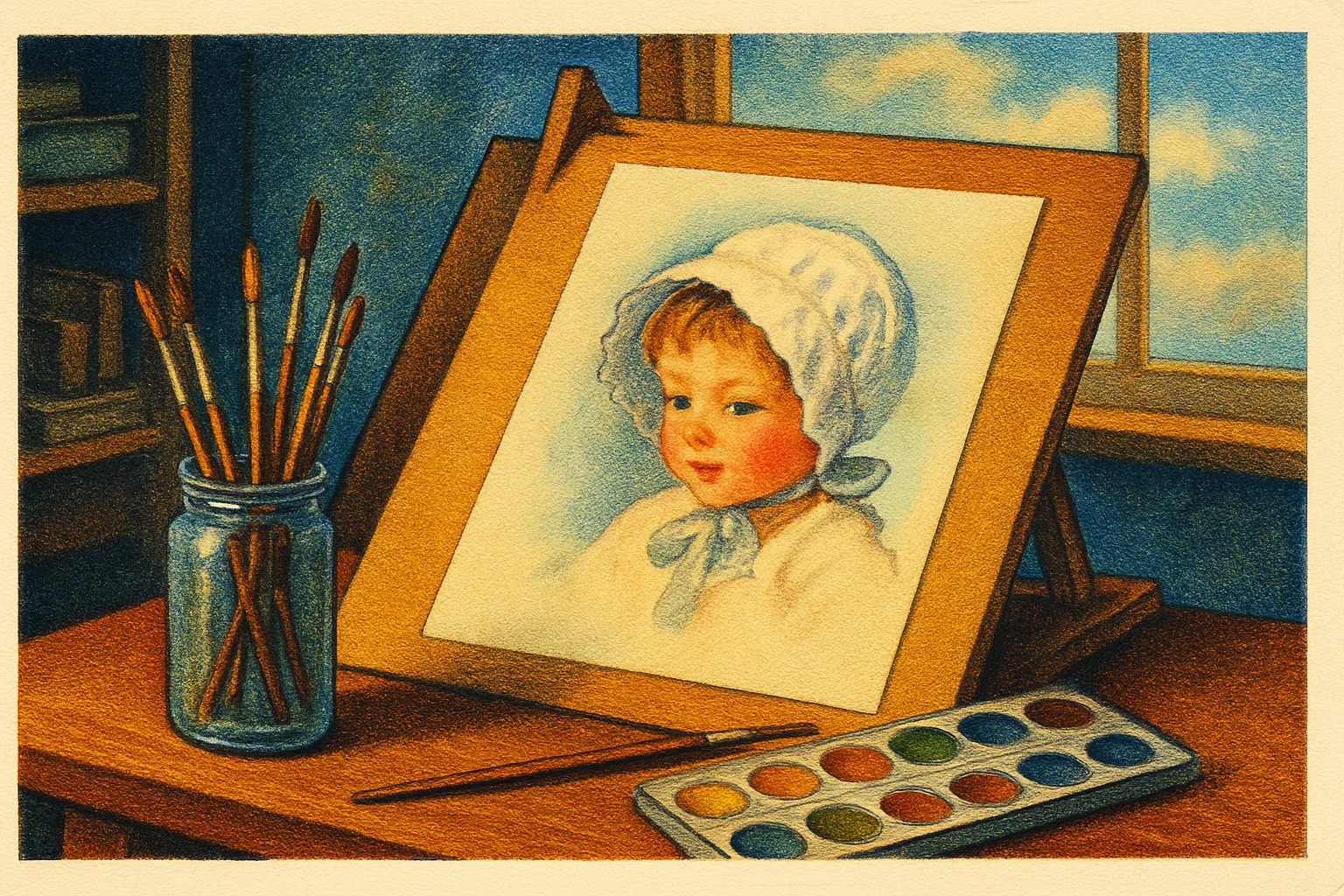
Early twentieth-century postcards weren't only photographs of places. Publishers commissioned illustrators to design greetings, glamour cards, children, animals, comic scenes and Art Nouveau panels, and some of those artists became famous for their postcard work. Their names often appear on the cards in small print, and collectors call these cards "artist-signed."
This guide explains what the term means, how to find and read a signature, which artists collectors most often look for, and the publishers they worked with.
What "artist-signed" means
In postcard collecting, artist-signed almost always means that the artist's signature is printed on the card as part of the design. The illustrator signed the original artwork, and the signature was reproduced along with the picture when the card was printed. Every copy of that design carries the same signature.
It doesn't usually mean the artist signed the card by hand. A card autographed in ink by the artist is something quite different, and very uncommon. If a listing says "artist-signed," assume a printed signature unless it clearly says otherwise and offers evidence.
Signed, unsigned and attributed
Not every design by a known artist carries a signature. Publishers sometimes cropped signatures out, printed variants without them, or never included them at all. Collectors use three categories:
- Signed: the artist's name, initials or monogram appears on the card.
- Unsigned: no signature, and no clear attribution.
- Attributed: unsigned, but identified as an artist's work by style, by the publisher's records, or by comparison with signed examples of the same design.
Signed cards generally draw more interest than unsigned cards of the same design. Attributions are useful, but they're opinions, and some are better supported than others. When I describe an unsigned card as being "in the style of" or "attributed to" an artist, I say what the attribution is based on.
How to find a signature
Signatures can be hard to spot, especially on busy designs. A few places to check:
- The lower corners of the image, left and right. This is where most signatures sit.
- Along an edge of the design, sometimes running vertically.
- Inside the picture, worked into a fence, a sign, a pumpkin, a tree trunk or the folds of a dress.
- In a border or panel below or beside the image, on Art Nouveau and decorative cards.
- On the back, where some publishers printed the artist's name, a series title or a line like "after the painting by."
Use a magnifier and good light. Signatures may be tiny, partly hidden by printing, or printed in a color close to the background.
Reading what you find
- Full names, like "Ellen H. Clapsaddle," are easy to read.
- Surnames only, like "Wall" or "Mucha," are common.
- Initials or monograms take more work. Collectors' reference books include lists of monograms, and comparing with signed cards by the same publisher helps.
- Copyright lines like "Copyright 1910 by" a publisher name the publisher, not the artist, though they help date the card.
Illustrators collectors look for
There were hundreds of postcard artists. These are some of the names most often sought by American collectors, with the publishers they're most associated with.
Ellen H. Clapsaddle (1865 to 1934)
Ellen Clapsaddle, from Herkimer County, New York, is often described as the most prolific postcard and greeting artist of her era, with thousands of designs credited to her. She worked principally for the International Art Publishing Company, which had offices in New York and Berlin, and she spent time in Germany working with the company's engravers.
Her cards cover nearly every holiday: Christmas, New Year, Easter, Valentine's Day, Thanksgiving, the Fourth of July, Halloween and birthdays. She's best known for round-faced, rosy-cheeked children, though she also drew women, flowers and patriotic designs. Her signature usually reads "Ellen H. Clapsaddle," and many of her designs also appeared unsigned.
Frances Brundage (1854 to 1937)
Frances Brundage, born in Newark, New Jersey, was a book illustrator as well as a postcard artist. She illustrated editions of children's classics and drew sentimental children and holiday greetings for Raphael Tuck & Sons and the Samuel Gabriel Company, among others. Her cards often show children in old-fashioned dress, playing, celebrating or in costume.
Rose O'Neill (1874 to 1944)
Rose O'Neill created the Kewpies, the round, impish little cherubs that first appeared in the Ladies' Home Journal in December 1909 and became a huge success as dolls, books and cards. Kewpie postcards were published by the Gibson Art Company of Cincinnati and the Campbell Art Company, among others, and they include holiday greetings and cards supporting women's suffrage. O'Neill's suffrage Kewpie cards are a popular collecting area of their own.
Harrison Fisher (1875 to 1934)
Harrison Fisher was one of the best-known magazine illustrators of his day, famous for his elegant portraits of young American women, often called "Fisher Girls." Many of his images were printed as postcards by Reinthal & Newman of New York, a publisher that specialized in art cards by well-known illustrators, and many of the designs come from his magazine cover art. Fisher cards are usually signed and often carry a series number and title.
Philip Boileau (died 1917)
Philip Boileau, born in Quebec, was another celebrated painter of women, known for soft, dreamy portraits. Like Fisher, much of his postcard work was published by Reinthal & Newman, much of it in the years around 1908 to 1911. His cards are usually signed and titled.
Alphonse Mucha (1860 to 1939)
Alphonse Mucha, the Czech artist whose posters for Sarah Bernhardt helped define Art Nouveau in Paris, also designed postcards. Most were printed by F. Champenois of Paris, the printer with whom he signed an exclusive contract in 1896, around the turn of the century. His sets, such as the twelve-card "Le Mois" months series, are among the most admired of all artist postcards. Mucha's work has been reprinted extensively ever since, so original Mucha postcards call for careful checking.
Bernhardt Wall (1872 to 1956)
Bernhardt Wall, an illustrator, etcher and lithographer, is credited with designing more than five thousand postcards, which earned him the nickname "Postcard King." Much of his work was for the Ullman Manufacturing Company of New York, including comic series, suffrage cards, holiday greetings and his versions of the popular Sunbonnet Babies, a style originally created by Bertha Corbett. He also worked for other publishers. His cards are often signed simply "Wall."
Samuel L. Schmucker (1879 to 1921)
Samuel Schmucker designed some of the most admired holiday cards of the golden age, especially for John Winsch, and earlier work for the Detroit Publishing Company. His Halloween and holiday women are prized by collectors. He rarely signed his Winsch cards, so most attributions rely on style. My guide to vintage Halloween postcards has more on Winsch and Schmucker.
Other names you'll see
A few other artists turn up often on American collectors' want lists:
- Louis Wain, the English artist famous for his anthropomorphic cats, many published by Raphael Tuck & Sons.
- Raphael Kirchner, an Austrian artist known for Art Nouveau and glamour cards.
- Howard Chandler Christy and Jessie Willcox Smith, both well-known American illustrators whose work was published by Reinthal & Newman, among others.
- Clarence Underwood, another illustrator of glamorous women.
Each of these artists has a following, and some have reference books devoted to their postcard work.
Publishers who commissioned artists
Knowing the publisher helps with dating, with identifying unsigned work, and with judging quality. A few publishers stand out for artist-designed cards:
- Raphael Tuck & Sons, London, which sold in America and printed many of its finest cards in Germany.
- International Art Publishing Company, New York and Berlin, Clapsaddle's main publisher.
- Reinthal & Newman, New York, for Fisher, Boileau, Christy and other illustrators, active in postcards from about 1906 to 1920.
- Samuel Gabriel Company, New York, for children's and holiday cards, including Brundage.
- John Winsch, New York, for holiday cards in the early 1910s.
- Ullman Manufacturing Company, New York, for Wall and many comic and holiday series.
- Gibson Art Company, Cincinnati, for holiday cards and Kewpies.
- F. Champenois, Paris, for Mucha and other French artists.
The publisher's name, series number and sometimes a design number usually appear on the back. Those details help you match a card against a checklist and spot variants.
Dating artist-signed cards
Artist cards date by the same clues as other cards. My guide to dating old postcards explains them in order, but for artist cards a few points stand out:
- Copyright lines. Many publishers printed a copyright year on the front or back. The card was printed that year or later.
- Back design. Undivided backs point to before March 1907, divided backs to 1907 or later.
- "Printed in Germany" is very common before the First World War. After 1914, many American publishers switched to domestic printers.
- The postmark, if the card was mailed, gives the latest possible date. My guide to reading postmarks helps with faint ones.
What makes some artist cards more desirable
Not every signed card is equally sought after. The factors that make a difference are much the same as for any postcard, as I explain in my guide to what makes a postcard valuable:
- The artist. Some names have far larger followings than others.
- The design. Within one artist's output, some designs are much more popular or much less common.
- The theme. Halloween, suffrage and some holiday designs are popular across collecting fields, which adds demand.
- Printing quality. Chromolithographed and embossed cards from the golden age are generally preferred.
- Condition. Clean corners, strong color, no creases.
- Completeness. Some collectors build whole sets, so a scarce card that completes a series can draw extra interest.
Watch out for reproductions
Popular artists have been reprinted heavily, Mucha, Fisher, Clapsaddle and Kewpie designs among them, on postcards, greeting cards and decorations. A signature on a card tells you whose design it is, not when the card was made. Before buying a card described as vintage:
- Magnify the printing. Look for a modern dot pattern compared with the deep color of early lithography.
- Check the back for a modern publisher, website, barcode or ZIP code.
- Check the size. Most early cards are about 3.5 by 5.5 inches.
- Feel the card stock and any embossing.
Questions people ask about artist-signed postcards
Is a signed card always worth more than an unsigned one? Usually, for the same design. But a strong unsigned design can be more desirable than a weak signed one.
How can I tell a printed signature from a real autograph? A printed signature sits in the same plane as the rest of the image and shows the same printing pattern under magnification. A real ink signature sits on top of the printing, often with visible pen pressure or ink variation. Hand-signed vintage postcards are uncommon.
Are cards by unknown artists worth collecting? Absolutely. Many fine cards were drawn by artists who are little known today, and they're often good value. Collecting by theme or publisher is just as rewarding as collecting by name.
Where can I learn more about one artist? Reference books and catalogs exist for many popular postcard artists, and some museums, such as the Museum of Fine Arts, Boston, have large postcard collections searchable by artist.
Where to go from here
When I list an artist-signed card, I note the signature and where it appears on the card, the publisher and series, and whether any attribution is my own judgment. You can browse my cards on the where to buy page, and read more about the eras and publishers in the rest of my collector's notes.