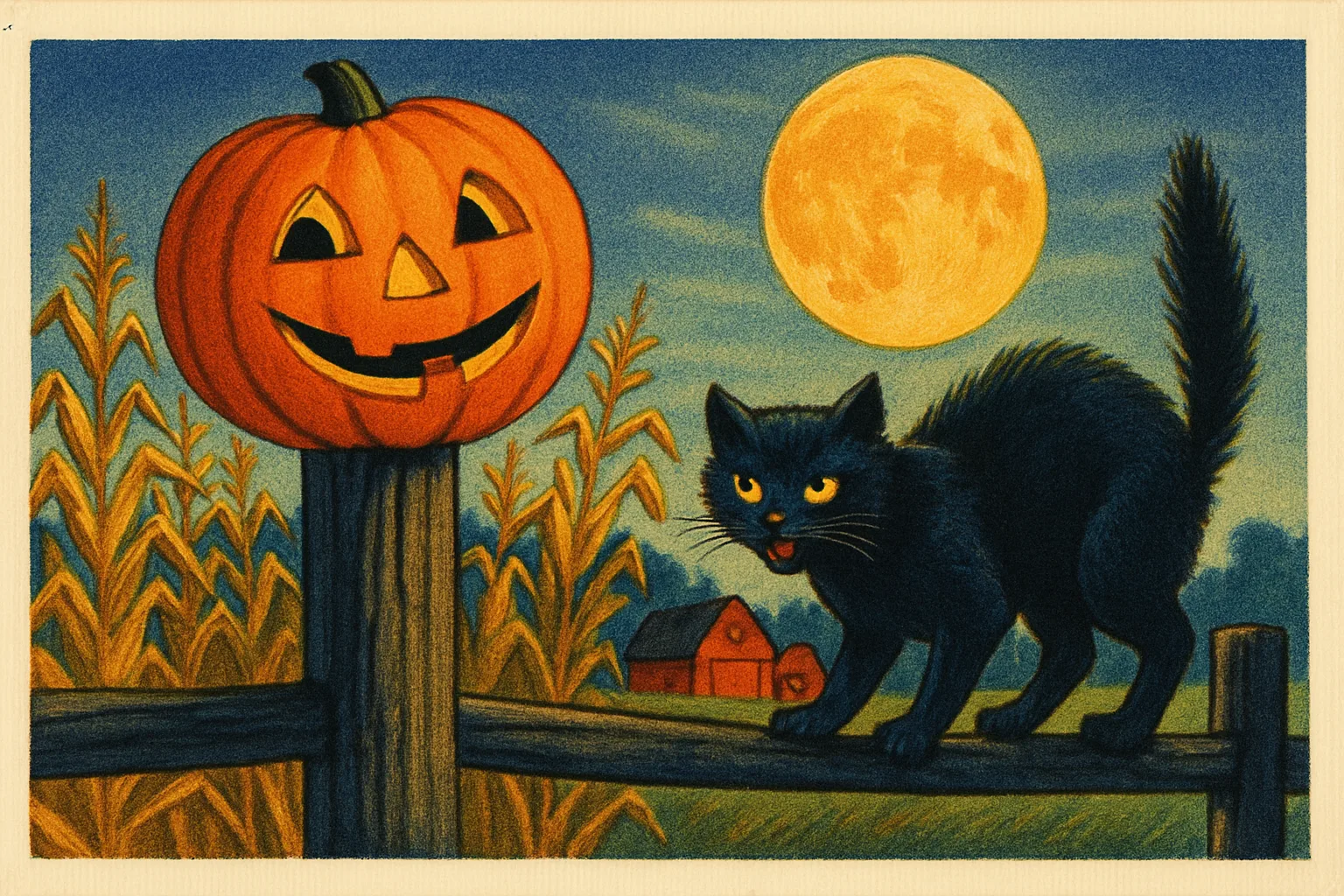
Halloween postcards are one of the most popular corners of postcard collecting. They're colorful, often beautifully printed, and full of a folk Halloween that looks quite different from the modern holiday: fortune telling, apple bobbing, courtship games, owls on fence posts and pumpkin-headed figures doing odd things in the moonlight.
This guide covers where these cards came from, the publishers and artists collectors look for, how they were made, what affects their condition and appeal, and how to avoid buying a modern copy by mistake.
The golden age of Halloween postcards
Holiday greeting postcards rode the same wave as every other kind of postcard. After the United States allowed a message on the back of a card from March 1, 1907, mailing postcards became a national habit. Greetings for every holiday followed: Christmas and New Year, Valentine's Day, Easter, St. Patrick's Day, the Fourth of July, Thanksgiving and Halloween.
Most collectors place the heyday of Halloween cards at roughly 1905 to 1915, with the busiest years falling after the divided back arrived. A few earlier cards exist, and Halloween cards kept being made through the 1920s and beyond, but the elaborate, embossed, richly colored cards that collectors prize most come from that first decade or so.
Two things ended the golden age. The First World War cut off the German printing houses that produced much of the finest color work for the American market, and the postcard fad itself faded as greeting cards in envelopes and, later, the telephone took over. Cards from the 1920s and 1930s are often simpler and flatter in printing, though some are charming in their own right.
How the holiday shows up on the cards
Early twentieth-century Halloween was largely a holiday of parties, games and superstitions about love and fortune, and the cards reflect that. Common themes include:
- Jack-o'-lanterns. Pumpkins carved with faces, often given arms and legs, or pumpkin-headed people.
- Witches. Usually on broomsticks, often with a black cat, an owl or a cauldron.
- Black cats, owls and bats. The standard companions of the witch.
- Fortune telling and romance. Young women looking into mirrors at midnight, roasting nuts, peeling apples in one long strip, or reading the future in a candle. Many cards carry little verses about seeing a future husband.
- Games. Apple bobbing, snap-apple, and ghostly pranks.
- Children in costume. Especially on cards by artists who specialized in children.
- Vegetable people. Figures made of corn, squash, cabbages and other harvest produce.
Some cards from the period also carry racial caricatures that were common in the era's popular imagery. They're part of the historical record, and collectors and archives describe them as such, but they're worth knowing about before you buy a mixed lot.
Publishers collectors look for
The name on the back of a Halloween card makes a large difference to collectors. A few publishers stand out.
John Winsch
John O. Winsch of New York published holiday cards in the early 1910s, and his Halloween cards are among the most sought after of all. Many carry a copyright line on the front or back such as "Copyright, 1911, John Winsch," with years running through about 1915. Winsch cards are known for strong color, careful embossing and elegant designs, many of them showing fashionable young women with pumpkins, cats and witches.
Much of Winsch's best work was designed by Samuel L. Schmucker (1879 to 1921), whose Halloween and holiday designs are admired for their Art Nouveau style. Schmucker rarely signed his Winsch cards, so most attributions are made by style. Treat a seller's "Schmucker" label as an opinion unless it's backed by comparison with documented examples. Collectors also prize Winsch designs by other artists, but the Schmucker-style women are the most famous.
Raphael Tuck & Sons
The London firm Raphael Tuck & Sons sold enormous numbers of cards in America, and many of its Halloween cards were printed in Germany, often in Saxony. Tuck numbered its cards in series, and the series number usually appears on the back alongside the words "Hallowe'en Post Cards." Tuck Halloween cards range from comic to sweet, and many are embossed.
International Art Publishing Company
International Art, based in New York and Berlin, published a huge volume of holiday cards, including many designed by Ellen Clapsaddle. Their Halloween cards often show round-faced children with jack-o'-lanterns, black cats and witches' hats.
Gibson Art Company
Gibson of Cincinnati produced holiday cards in the 1900s and 1910s, including Halloween designs. Gibson commissioned work from a number of artists, Bernhardt Wall among them.
Others you'll see
Many other publishers produced Halloween cards, and some are well respected by collectors. You'll see names such as Nash, Whitney, Stecher, the Samuel Gabriel Company and the Souvenir Post Card Company of New York, along with many cards that carry no publisher name at all. Unmarked cards aren't necessarily lesser. Some unmarked German cards are as fine as anything with a famous name on the back.
Artists collectors look for
A signed card by a known artist usually draws more interest than an unsigned card of a similar design. My guide to artist-signed postcards covers how to find signatures and what they mean, but these are the names you'll meet most often on Halloween cards.
Ellen H. Clapsaddle (1865 to 1934) was one of the most prolific postcard illustrators of her time, with thousands of designs credited to her, mostly for the International Art Publishing Company. Her Halloween children, with their wide eyes and rosy cheeks, are easy to recognize. Her signature, "Ellen H. Clapsaddle," often appears small near a bottom corner, but many of her designs were printed unsigned.
Frances Brundage (1854 to 1937) illustrated children's books and drew sentimental children for Raphael Tuck & Sons, the Samuel Gabriel Company and others. Her Halloween cards often show children in costume or playing with pumpkins.
Samuel L. Schmucker, discussed above, is associated with John Winsch's best Halloween designs.
Bernhardt Wall (1872 to 1956), known as a prolific postcard designer, produced Halloween cards among a vast range of other subjects.
Plenty of fine Halloween cards are unsigned or signed by artists who are little known today. Judge the card in front of you on its own merits as well as the name.
How they were made
Chromolithography and German printing
The finest early Halloween cards were printed by chromolithography, a process that used a separate stone or plate for each color. The result is deep, layered color that a later halftone card can't match. Germany, and Saxony in particular, was the center of this work, which is why so many cards say "Printed in Germany" or "Printed in Saxony" on the back.
Embossing
Many Halloween cards are embossed: the card stock was pressed so that parts of the design stand up from the surface. Run a fingertip lightly over the front and you'll feel the raised pumpkins, cats and borders. Embossing adds depth and catches the light, and collectors generally prefer it. Heavily embossed cards are also more fragile at the raised points, which can rub, flatten or crack.
Gold, glitter and other finishes
Some cards were finished with gilt highlights, metallic inks or glitter. Gold often survives well, but glitter tends to shed over the years. A card with most of its original glitter is a nicer example than one that has lost most of it.
Mechanical and novelty cards
A smaller number of Halloween cards have moving parts: pull-tabs, wheels, or panels that change the picture. These mechanicals are popular with collectors and fragile. Check that every part is present and still works.
Dating a Halloween card
The same clues work on holiday cards as on views. My guide to dating old postcards explains them in detail, but for Halloween cards the most useful are:
- The back design. An undivided back points to before March 1907. A divided back points to 1907 or later.
- Copyright dates. Winsch and some other publishers printed a copyright year on the card. That's the year the design was registered, so the card was printed in that year or later.
- "Printed in Germany" or "Saxony." Very common before the First World War, much less so after.
- The postmark. If the card was mailed, the postmark gives the latest possible date. Many Halloween cards were mailed in the last days of October, so the month is often a nice confirmation. My guide to reading postmarks explains how to make sense of a faint one.
- The stamp. A one-cent stamp is typical. A two-cent stamp on a domestic card may point to the wartime rate of late 1917 to mid-1919.
What collectors look for
Halloween cards vary widely in appeal, and a handful of factors account for most of the difference. My guide to what makes a postcard valuable goes into these in more depth.
- Publisher and artist. Winsch, Tuck, International Art and signed Clapsaddle or Brundage cards draw steady interest, and attributed Schmucker designs are among the most wanted.
- Strength of the design. A bold witch on a broomstick against a full moon has more eye appeal than a small pumpkin in a corner. Cards where the Halloween imagery fills the front are generally preferred.
- Printing quality. Deep chromolithographed color, crisp embossing and intact gilt.
- Scarcity of the design. Some designs were printed in large numbers and turn up all the time. Others are seldom seen.
- Condition. Clean, sharp corners, no creases, strong color and no album damage.
- Mechanicals and novelties. Working moving parts add interest.
A card doesn't have to be expensive to be worth having. Many collectors start with ordinary Halloween greetings and add the famous names over time.
Condition: what to check
Condition matters a great deal with holiday cards because so many were kept in albums, handled often and stored in attics. Before buying, look closely at:
- Corners and edges. Rounding, softening and small chips are the most common flaws.
- Creases and bends. A crease that breaks the surface is more serious than a gentle bend.
- Embossing wear. Flattened or rubbed high points, especially on faces and pumpkins.
- Fading. Orange and red inks can fade after long exposure to light. Compare the front with any protected area, such as under an album corner.
- Album marks. Residue, slits or paper remains at the corners from old albums.
- Writing on the front. Common on early cards, especially before 1907. Neat writing in the margin bothers some collectors more than others.
- Trimming. Some cards were cut down to fit albums. Measure the card and look for edges that are too clean or uneven.
The scan should show all of these. If it doesn't, ask the seller.
Reproductions: what to watch for
Vintage Halloween designs are so popular that modern reproductions are everywhere: reprinted postcards, greeting cards, wrapping paper and decorations. Most are sold honestly as reproductions, but they sometimes end up in antique malls, mixed lots and listings where the seller doesn't know the difference. A few checks catch most of them.
- Magnify the printing. Early chromolithographs have rich, solid color with a fine grain. A modern reproduction is usually printed with a regular dot pattern, often a rosette of four colors, which shows clearly under a loupe or a phone camera zoomed in.
- Feel for embossing. Most reproductions are flat. Some modern cards have embossing too, so this test only rules cards out, it doesn't prove age.
- Look at the card stock. Old card stock is usually softer and slightly toned. Modern stock is often bright white, very smooth or glossy, and sometimes thicker or thinner than you'd expect.
- Read the back. Many reproductions say so, or carry a modern publisher's name, a barcode, a website address, a ZIP code or a copyright date from recent decades. An undivided back on a card with modern printing is a warning sign.
- Check the size. Most vintage American postcards are about 3.5 by 5.5 inches. Many modern cards are 4 by 6 inches.
- Be wary of a perfect card at a casual price. A bright, flawless "Winsch" with no back markings deserves a closer look before you buy.
When I list a Halloween card, I describe the printing, the embossing and the back, and I scan both sides so you can check these things for yourself.
Storing and displaying Halloween cards
Halloween cards are tempting to display every October, and there's nothing wrong with that if you do it carefully. Light is the main enemy of those orange and black inks.
- Keep cards in archival sleeves made of polypropylene or polyester, never PVC.
- Display them away from direct sunlight, and for a limited time rather than year-round.
- If you frame a card, use UV-filtering glazing and acid-free mats, and don't glue or tape the card itself.
- Store embossed cards flat, without pressure on top, so the raised areas don't flatten.
My guide to storing old postcards covers sleeves, boxes, humidity and the rest in more detail.
Questions people ask about Halloween postcards
Why do so many say "Hallowe'en"? The apostrophe is short for "even," as in "All Hallows' Even," the evening before All Saints' Day. The spelling with an apostrophe was common in the early twentieth century and gradually dropped out of use.
Are Halloween postcards more valuable than other holiday cards? Collectors generally treat Halloween as one of the most sought-after holidays, probably in part because far fewer Halloween designs were made than Christmas ones. But value still depends on the particular card, its publisher, its design and its condition. A common, worn Halloween card isn't automatically worth more than a fine Christmas card.
Does a postmark on October 30 or 31 matter? It's a pleasant detail, and it confirms the card was used as intended, but on its own it doesn't change much. Collectors mostly care about the front. A clear, early postmark from a small town can add a little interest for postal history collectors.
Is an unsigned card worth less than a signed one? Often, but not always. Many excellent designs were printed without a signature, including most of the Winsch cards attributed to Schmucker. A strong design in fine condition can outshine a weak signed card.
How can I start a Halloween collection without spending much? Start with ordinary greetings in good condition from the 1905 to 1915 era, learn the publishers by their backs, and add better cards as you learn to recognize them. A focused theme helps: witches only, black cats only, one publisher, or one artist.
Where to look
Halloween cards turn up in estate sales, postcard shows and online listings year-round, though interest naturally rises in the autumn. When I list them, each card gets a date range, the publisher and series where I can identify them, the artist when there's a signature, and a plain description of the condition. You can browse what I currently have on my where to buy page, and the rest of my collector's notes explain the clues I use to describe every card.