Postcards are paper, ink and, in the case of real photos, photographic emulsion. All three are damaged by the same handful of things: light, heat, damp, acidic materials, chemically unstable plastics, and careless handling. The good news is that protecting a collection doesn't take special equipment or much money. It mostly takes choosing the right sleeves and boxes, and keeping them in the right part of the house.
This guide covers the materials to use and avoid, where to store a collection, how to handle cards, and what to do with problems like mold, curling and old albums.
The short version
- Put each card in an archival sleeve made of polypropylene or polyester. Never PVC.
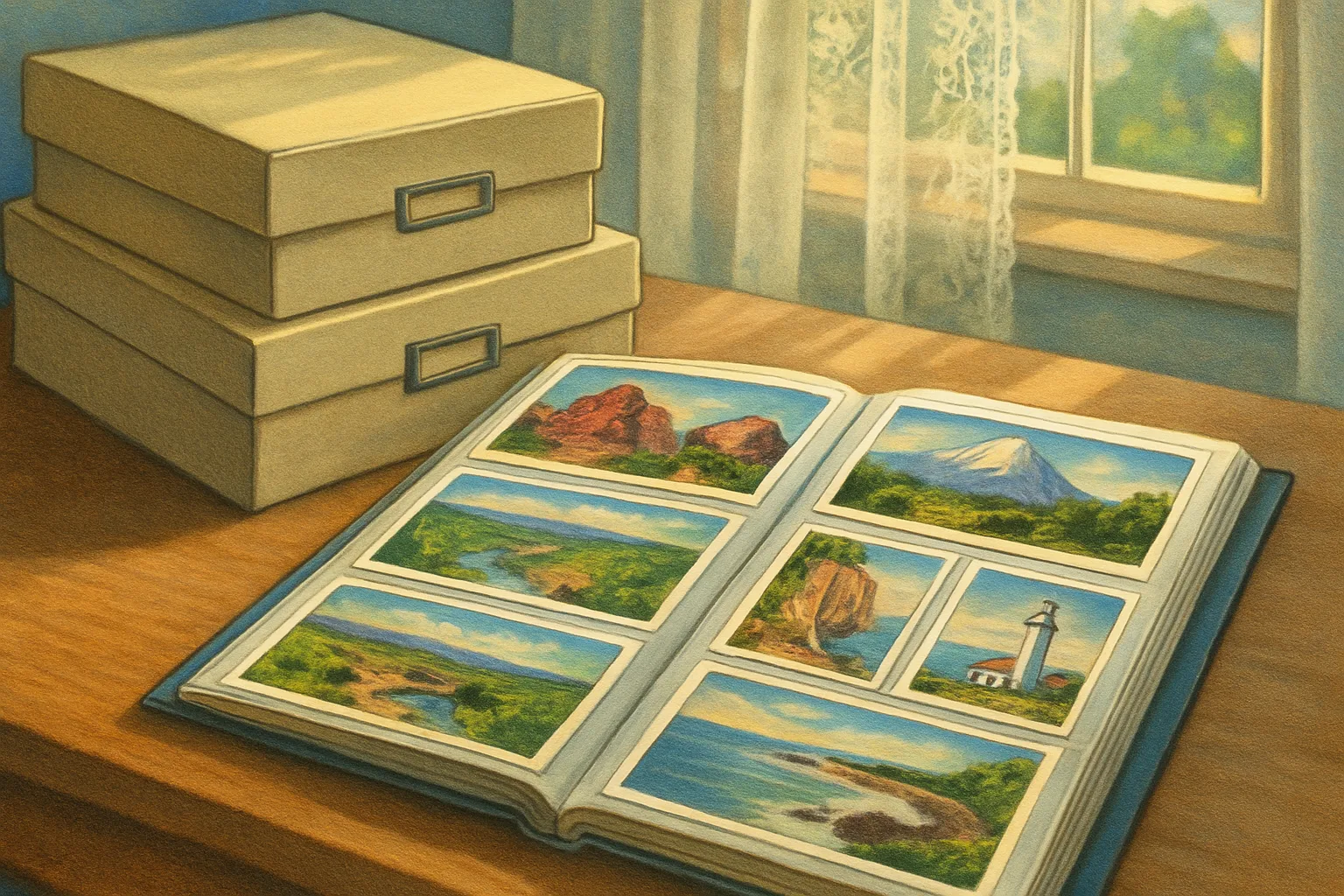
- Store the sleeved cards upright in an acid-free box or in an album with archival pages.
- Keep the collection cool, dry, dark and stable: a closet or cabinet in the lived-in part of the house, not an attic, basement or garage.
- Handle cards by the edges, with clean, dry hands.
- No rubber bands, paper clips, tape, glue or magnetic albums.
The rest of this guide explains why, and what to do in the less straightforward cases.
Sleeves
A sleeve is the most important single piece of protection. It keeps fingerprints, dust and abrasion off the card, and it lets you handle and look at a card without touching it.
What to look for
- Polypropylene. The most common archival sleeve material. It's clear, chemically stable, inexpensive and soft enough to slide cards in and out easily.
- Polyester. Often sold under trade names like Mylar. Polyester is the most inert and rigid of the common archival plastics, and it's the choice of many archives for valuable photographs. It costs more, and its stiffness gives a card more support.
- Polyethylene. Also acceptable, though it's softer and less clear than the other two.
- No coatings or plasticizers. The sleeve should be plain plastic, uncoated.
- "Passes the PAT." The Photographic Activity Test is an international standard test for whether a storage material will harm photographs. For real photo postcards especially, look for sleeves that say they pass it.
What to avoid
- PVC (polyvinyl chloride). Flexible PVC contains plasticizers and can break down over time, giving off harmful chemicals and leaving a sticky or oily film. Preservation organizations consider PVC unacceptable for photographs, and it's no better for printed cards. If a plastic sleeve or album page smells strongly of "new plastic," feels tacky, or is very soft and clingy, be suspicious. Older vinyl pages from the 1970s and 1980s are a common culprit.
- Unlabeled plastic. If you don't know what it is, don't trust it with a card you care about.
Size
Standard vintage postcards are about 3.5 by 5.5 inches, and most postcard sleeves are made a little larger. Later "continental" cards are about 4 by 6 inches and need a larger sleeve. Measure a few cards before you buy in bulk, and choose sleeves that fit without bending or squeezing the card. A sleeve that's too tight can curl or crease a card as you push it in.
Rigid holders
For a card you particularly value, or one that's going in the mail, a sleeved card can go inside a semi-rigid or rigid holder for extra support. For long-term storage, a sleeve in a well-fitted box is usually enough.
Boxes
Most collectors store sleeved cards upright in boxes, filed like an index.
- Use acid-free, lignin-free boxes. Ordinary cardboard and wooden boxes give off acids as they age, which yellow and weaken paper. Archival boxes are made to avoid that. Look for boxes described as acid-free and lignin-free, ideally buffered for printed cards.
- Store cards upright, snug but not tight. Cards should stand on their long edge without slumping or being jammed. If a box isn't full, use a spacer or a piece of acid-free board to keep the cards upright.
- Avoid overfilling. Packing too tightly makes cards hard to remove and can scuff them as they come out.
- Use dividers. Acid-free dividers let you sort by state, town, topic or publisher.
- Label the outside. It saves handling, since you'll go straight to the right box.
Cards stored flat in a stack also work, especially for fragile or embossed cards, but don't stack them high. Weight presses down on the lower cards and can flatten embossing.
Albums
Albums are lovely for display and for looking through a collection, and many collectors use them for their best cards.
- Archival pages. Choose pages made of polypropylene or polyester, sized for postcards, with pockets that hold the cards without adhesive.
- A sturdy binder. A D-ring binder holds pages flat and straight. Choose one with an acid-free or plastic cover rather than vinyl.
- Store albums upright, like books, and don't overfill them.
Magnetic albums
The "magnetic" photo albums popular from the 1970s onward, with a sticky page under a clear plastic film, are among the worst things for old cards. The adhesive yellows, becomes very sticky or very brittle, and can stain the back of the card or bond with it. The plastic film is often PVC.
If you have cards in a magnetic album, remove them if you can do so safely. Try sliding a thin, smooth, blunt tool, like a piece of dental floss or a thin plastic spatula, under one corner, and work it slowly under the card. If the card resists, stop. A card left in an old album is better than a card with its back torn off. A conservator can remove stubborn cards safely.
Old scrapbook and corner albums
Many early 1900s cards come from albums with slots or paper corners. If the cards slide out easily, sleeve them and store them properly. If they're glued down, leave them. The album itself can be a historical item, and some collectors keep albums intact because the arrangement tells a story about the person who made it.
Where to keep a collection
Light
Light, and especially ultraviolet light from the sun and from some fluorescent lamps, fades inks and photographs and yellows paper. The damage is cumulative and permanent.
- Store cards in closed boxes or albums.
- Keep them away from windows.
- If you display cards, rotate them, use UV-filtering glass, and avoid direct sun.
Temperature and humidity
Heat speeds up the chemical reactions that age paper and photographs. Damp encourages mold and makes cards curl. Very dry conditions make paper and emulsion brittle. Swings between hot and cold, or damp and dry, are worse than any steady condition, because they make the paper expand and contract.
The Library of Congress recommends about 30 to 50 percent relative humidity and a temperature of 70°F or below for photographs, in a stable environment. That's a good target for a whole postcard collection. You don't need to measure precisely. An inexpensive hygrometer will tell you whether a room is reasonable.
In practice, that means:
- Good places: an interior closet, a cabinet or a bookshelf in the main living area of the house, away from outside walls.
- Bad places: attics, which get very hot; basements, which are damp; garages and sheds, which swing with the weather; and anywhere near a radiator, heater, air conditioner vent, kitchen, bathroom or laundry.
- Off the floor. Keep boxes a little above floor level, in case of leaks or floods.
Pests
Silverfish, cockroaches and mice will eat paper and the starches in old adhesives. Clean, closed boxes in a clean, dry room are the best protection. Check your collection now and then.
Handling
- Clean, dry hands. Wash and dry your hands before handling cards. Skin oils transfer to paper and especially to the surface of real photos.
- Hold by the edges. Avoid touching the image area, particularly on photographs.
- Gloves. Nitrile gloves are useful for real photos and valuable cards. Cotton gloves are often recommended, but they reduce your grip and can snag on rough edges, so many people find nitrile easier.
- Work on a clean, clear surface. No food or drinks nearby.
- Support the card. Lift fragile or cracked cards on a piece of stiff card rather than by a corner.
Things not to do
These are the habits that damage the most cards.
- Rubber bands. They dent the edges, and as they age they become sticky or crumble, leaving residue that stains.
- Paper clips and staples. They rust, dent and tear.
- Tape. Cellophane tape yellows and its adhesive stains through the paper. Masking tape is just as bad. Never use tape to repair a tear.
- Glue. Never glue cards into albums or scrapbooks.
- Pens near cards. Write notes on a separate sheet or on the sleeve label, not on the card. If you must mark a card, use a soft pencil, lightly, on the back.
- Trimming. Never cut a card to fit a sleeve or frame. Buy the right sleeve instead.
- Cleaning with liquids or erasers. Water, solvents and erasers can remove ink, damage photographs and leave marks. Light surface dust can be removed with a soft, clean brush. Anything more is a job for a conservator.
- Lamination. It's permanent and destroys the card's value for collectors.
- Soaking off stamps. A stamp on its original card, with its postmark, is part of the card's history. My guide to reading postmarks explains why those marks are worth keeping.
Curling
Cards curl when one side absorbs or loses moisture faster than the other. Real photos are especially prone to curl because the emulsion behaves differently from the paper behind it.
- Mild curl often flattens on its own if the card is stored upright in a sleeve in a box with neighbors to support it, or flat under a light weight in a stable room.
- Don't force it. Bending a curled card flat can crack the surface, especially on a photograph.
- Don't iron or steam. Heat and moisture can damage emulsion and inks.
- Serious curl on a valuable card is a job for a paper or photograph conservator, who can humidify and flatten it safely.
Mold
Mold appears as fuzzy or powdery spots, often white, gray, green or black, sometimes with a musty smell. It's common in collections that spent years in a damp basement or barn.
- Separate the affected cards from the rest of the collection right away, in a sealed bag or box, so the spores don't spread.
- Protect yourself. Mold can be a health hazard. Wear gloves and a well-fitted mask, and work outdoors or in a well-ventilated space.
- Dry first. If cards are damp, let them dry in a cool, dry, well-ventilated room, out of direct sun. Mold that's dry and inactive is much easier to deal with.
- Brush gently, once dry. A soft brush, used outdoors, can remove loose dry mold.
- Fix the cause. Don't return the collection to the place where the mold grew.
- Call a conservator for valuable or heavily affected cards.
Brown spots that don't brush off are often foxing, a different kind of age staining. It can't be safely removed at home, and it's best left alone.
Inherited collections
A box of cards from a parent or grandparent can be a wonderful thing, and it's often in a fragile state. Take it slowly.
- Don't rush to sort. First, look at how the cards were kept. An album, a bundle tied with ribbon, or cards grouped by sender may tell a family story worth recording before you change anything.
- Photograph the arrangement before taking anything apart.
- Remove harmful materials. Take off rubber bands, clips and string carefully. Leave anything stuck down.
- Sort into simple groups. Real photos, printed views, greetings, and family messages, for example.
- Sleeve and box. Start with the cards that seem most important to you or most fragile.
- Record what you learn. A notebook or a spreadsheet with each card's sender, date and subject turns a box of cards into a family archive.
- Read the messages. Family cards often carry names, places and dates that are useful for genealogy.
If you want to know what you have, my guides on how to date an old postcard, real photo postcards and what makes a postcard valuable will help you sort the cards and understand them.
Special cases
- Real photo postcards are the most sensitive. Use sleeves that pass the PAT, keep them out of light, and handle them as little as possible.
- Embossed cards, including many early Halloween and other holiday greetings, should be stored upright or flat without pressure, so the raised areas don't flatten. My guide to vintage Halloween postcards covers those cards in more depth.
- Glitter cards shed. A sleeve keeps the glitter with the card and off your other cards.
- Mechanical and novelty cards, with moving parts, silk, leather or other materials, need extra support. A rigid holder or a separate small box helps.
- Linens fade under light. My guide to linen postcards explains what to look for.
Displaying cards
There's nothing wrong with putting a favorite card on the wall, as long as you accept that light does some damage over time. To limit it:
- Use acid-free mats and backing, and mount the card with archival corners rather than glue or tape.
- Use UV-filtering glass or acrylic.
- Hang it on an inside wall away from sunlight and heat.
- Rotate displayed cards every few months, so no single card spends years in the light.
How I store and ship cards
Every card I handle goes into an archival sleeve as soon as it's sorted, and lives in a numbered acid-free box. When a card sells, it goes out in its sleeve, inside a rigid holder or a stiff mailer. When it arrives, keep it in the sleeve and move it to a box or album as above, and it'll be in the same condition years from now. You can see the cards I have now on my where to buy page.