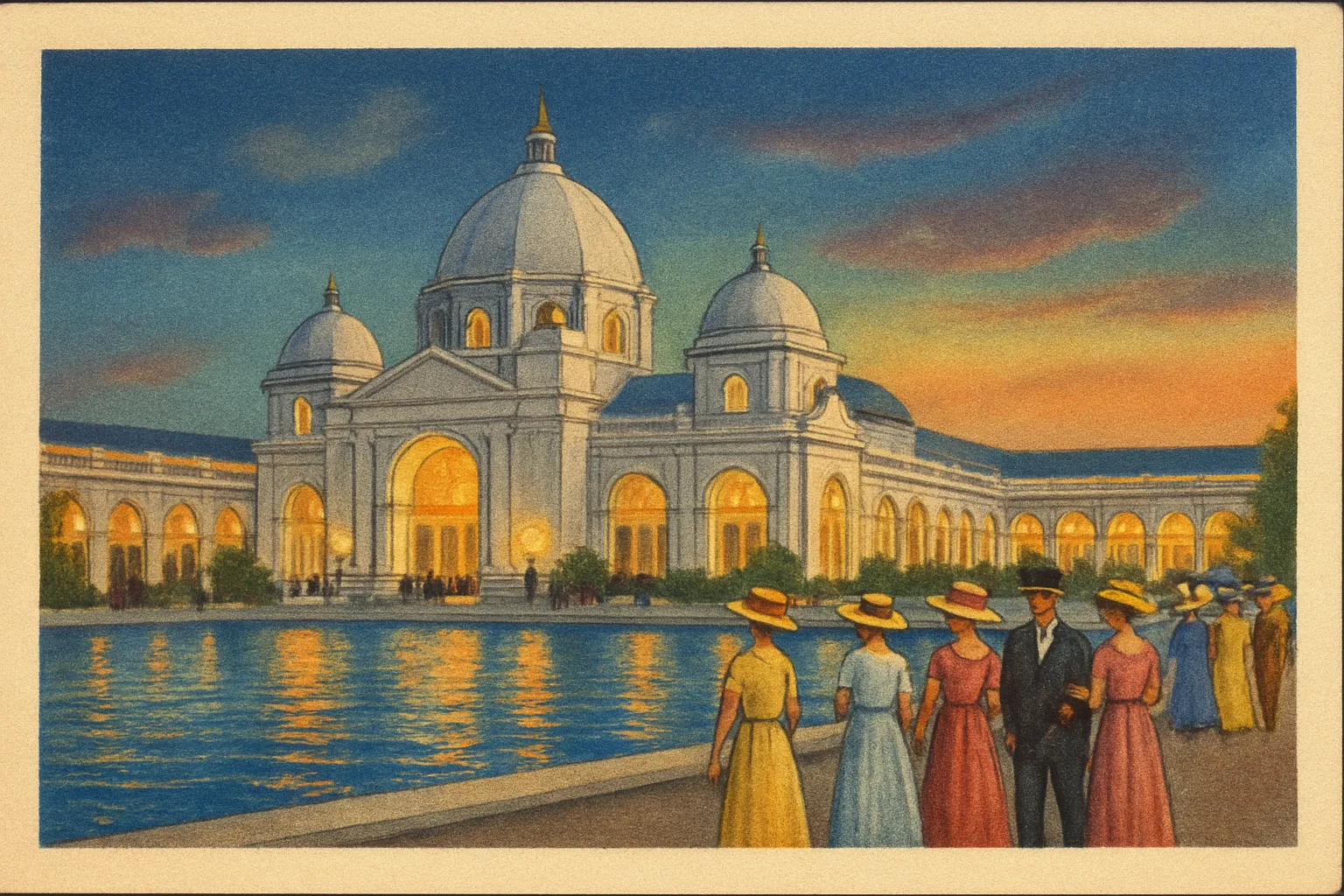
Few subjects tie into the history of the postcard as neatly as the world's fair. The great American expositions were built to be seen, photographed and remembered, and the postcard was the cheapest way to take a piece of one home or to tell someone back home that you had been. From the 1890s to the eve of the Second World War, every major fair produced cards by the thousand, and many produced them by the million.
For a collector, exposition cards are a nice mix of history and detective work. They come with built-in dates, a clear set of subjects, and a split between official cards and everything else. This post walks through the main American fairs from 1893 to 1940, what their cards look like, and what collectors tend to look for.
Why the fairs mattered to postcards
The 1893 World's Columbian Exposition in Chicago arrived at an awkward moment for picture postcards. Privately printed cards were legal, but they had to pay the two-cent letter rate, while the government's own postal cards went for a penny. The private picture postcard as most people know it, mailed for one cent, didn't arrive until the Private Mailing Card Act of May 19, 1898. My post on the penny postcard covers the rate history in more detail.
The fairs worked around that problem in different ways, and in doing so they got millions of Americans used to the idea of buying a picture card, writing a line on it and putting it in the mail. By the time the rules loosened, the habit was already forming.
1893: The World's Columbian Exposition, Chicago
The Columbian Exposition ran from May 1 to October 30, 1893, and its cards are the usual starting point for any history of the American picture postcard.
The best known are the official souvenir cards produced by Charles W. Goldsmith, who represented the American Lithographic Company of New York. Goldsmith received the fair's contract in April 1893 and printed color views of the exposition buildings onto government postal cards, so each one already carried its one cent of postage. His set of ten showed buildings such as the Administration Building, the Woman's Building, the Fisheries Building and the Manufactures and Liberal Arts Building. On the grounds, the cards were sold from vending machines, two for five cents.
Two cautions are worth keeping in mind:
- "The first American picture postcard" is a slightly loose claim. Goldsmith's cards are widely described as the first American postcards printed specifically as souvenirs, and they did more than anything else to popularize picture cards. But an advertising card for an earlier Chicago exposition, the Interstate Industrial Exposition of 1873, is sometimes cited as an earlier picture card, and other private distributors also printed exposition views on government postals in 1893. "The first official souvenir postcards in America" is the safer description.
- Varieties exist. Collectors note differences within the Goldsmith cards, such as cards with and without the official seal, and other publishers' 1893 views exist alongside them. Count claims in the sources vary, so check a specialist reference before calling a set complete.
There is also a modern trap. A reprint of the Goldsmith cards and their wrappers was produced in 1993 for the fair's centennial. A crisp, bright "1893" card deserves a careful look, and my notes on how to spot a reproduction postcard explain what to check.
1898: The Trans-Mississippi and International Exposition, Omaha
Omaha's fair ran from June 1 to November 1, 1898, which means it straddled a turning point. The new one-cent rate for privately printed "Private Mailing Cards" took effect on July 1, 1898, a month after the fair opened.
Collectors describe a set of ten official views printed in soft colors on government postal cards, showing artist's conceptions of the main buildings. Privately printed cards of the fair exist too. The exposition also had its own commemorative stamps, the Trans-Mississippi issue of 1898, which turn up on period mail.
As with Chicago, watch for later productions. A set of photographic cards of the Omaha buildings was published in 1992 by a local historical association. These were made openly as commemoratives, but once separated from their packaging they can confuse a newcomer.
1901: The Pan-American Exposition, Buffalo
The Pan-American Exposition opened on May 1, 1901 and closed at the start of November. Most sources give November 2, though the fair's own catalogue printed November 1. It is remembered for its electric lighting, powered from Niagara Falls, and for the shooting of President William McKinley at the fair's Temple of Music on September 6, 1901.
Official souvenir cards carry the line "Official Souvenir Mailing Card" and a copyright notice from the Niagara Envelope Manufactory of Buffalo, with lithography credited to firms such as Gies & Co. Catalog records spell the publisher's name in more than one way, so search under both "Niagara Envelope Manufactory" and "Niagara Envelope Manufacturing Company."
Buffalo is also where postal markings get interesting. The government's 1901 commemorative stamps were inscribed "Commemorative Series, 1901" rather than with the exposition's name, and the fair was promoted instead through a range of special cancellations, including some of the earliest American slogan cancels. Cards and covers with those markings interest postal historians as much as card collectors. My guide on how to read a postmark explains the different cancel types.
Because the fair came just before the "Post Card" wording was permitted on private cards in December 1901, a Buffalo card's back design is itself a clue to when it was printed.
1904: The Louisiana Purchase Exposition, St. Louis
The St. Louis World's Fair opened on April 30, 1904 and ran into early December. It was enormous, and so was its postcard output.
The official souvenir cards were published by the Samuel Cupples Envelope Company of St. Louis, and their backs carry "Official Souvenir" wording. Cupples cards showed the great exhibit palaces, the lagoons, the state buildings and the night illuminations. A huge number of unofficial cards were published as well, by national and local firms alike.
Two things make 1904 cards distinctive:
- They are undivided backs. In 1904 the back of a postcard was still reserved for the address, so visitors wrote their messages on the front, around or across the picture. A St. Louis card with a few lines squeezed into the sky is entirely typical. My post on what the address side tells you has more on reading the backs of these early cards.
- The subjects are wide. Beyond the buildings, cards covered foreign pavilions, the amusement area known as the Pike, and exhibits of every kind. Some subjects reflect the attitudes of the time in ways that are uncomfortable today, and collectors and historians treat those cards as historical evidence rather than as novelties.
1907: The Jamestown Exposition, Norfolk
The Jamestown Exposition marked the 300th anniversary of the Jamestown settlement. It was held on the waterfront at Sewell's Point near Norfolk, Virginia, rather than at Jamestown itself, and ran from April 26 to December 1, 1907.
Its official cards were published by the fair's concessionaire, the Jamestown Amusement & Vending Company of Norfolk, with printing credited to the American Colortype Company of New York. They are numbered, and they include state buildings, exhibit halls and views of the naval presence that was a large part of the fair. Commemorative stamps were issued for Jamestown as well.
Timing makes Jamestown cards useful for teaching. The divided back became legal in the United States on March 1, 1907, less than two months before the fair opened, so both older and newer back designs turn up. My guide on how to date an old postcard explains why that change matters so much.
1909: The Alaska-Yukon-Pacific Exposition, Seattle
Seattle's fair ran from June 1 to October 16, 1909, on what is now the campus of the University of Washington. The grounds were laid out by John Charles Olmsted, and the central vista toward Mount Rainier survives as part of the campus today. A two-cent stamp was issued for the fair.
The Portland Post Card Company, with addresses in Portland and Seattle, published many views of the exposition, often printed in Germany, which was still the source of most fine American postcard printing at the time. I've seen it described as an official publisher, but I haven't found an archival source that confirms its exact status, so I treat that claim with care. Real photo postcards of the fair exist too, and they are a separate pleasure from the printed views.
1915: The Panama-Pacific International Exposition, San Francisco
The Panama-Pacific International Exposition celebrated the opening of the Panama Canal and San Francisco's recovery from the 1906 earthquake. It ran from February 20 to December 4, 1915.
The Cardinell-Vincent Company held official roles at the fair, both as a photographer and as a postcard publisher, and cards with "Official Post Card" and the Cardinell-Vincent name are common. Some were printed by Curt Teich of Chicago. The fair's Tower of Jewels, its Palace of Fine Arts and its lighting effects were all popular subjects. San Diego held its own Panama-California Exposition in the same period, and the two fairs are easy to mix up in a box of unsorted cards, so read the caption.
By 1915 the First World War had cut off the German printing that had dominated American postcards, and you can sometimes see the shift in the printing quality and in the white borders that began appearing on American cards around this time.
1926: The Sesquicentennial International Exposition, Philadelphia
Philadelphia's fair marked 150 years since the Declaration of Independence. Sources disagree slightly on the exact dates, but it opened at the end of May or start of June 1926 and closed at the end of November or start of December. It was a disappointment by most measures. Attendance fell far short of what organizers hoped for, and rain fell on more than half of the days it was open.
For collectors, that means fewer Sesquicentennial cards than you might expect for a fair of its size. The best-known image is the giant illuminated replica of the Liberty Bell that stood over the entrance. Cards from this fair are typically white-border views, the standard look of the 1920s.
1933 to 1934: A Century of Progress, Chicago
Chicago's second great fair marked the city's centennial. It opened on May 27, 1933, closed for the winter, and reopened for a second season from May 26 to October 31, 1934. Its modern buildings and bold color schemes made a striking contrast with the classical white palaces of 1893.
Cards marked "Official Post Card of A Century of Progress" were published by the Reuben H. Donnelley Corporation and printed by R. R. Donnelley & Sons, which was the fair's official printer. Many other firms published cards too. These years overlap with the arrival of linen postcards, so you'll find Century of Progress cards in more than one printing style. My guide to linen postcards explains how to tell the types apart and read their publisher codes.
The two seasons are worth noting. A card's caption, postmark, or the exhibits it shows can sometimes tell you whether it belongs to 1933 or 1934.
1939 to 1940: The New York World's Fair
The New York World's Fair opened in Flushing Meadows, Queens, on April 30, 1939, and ran for two seasons, closing in late October 1940. Its theme was "The World of Tomorrow," and its symbols, the tall spire called the Trylon and the great sphere called the Perisphere, are among the most recognizable images in American design.
Grinnell Litho cards carry an official license line naming the New York World's Fair and a license number, and state that they were made for the Exposition Souvenir Corporation. Plenty of unlicensed cards were sold too. Fair cards from these years range from linens to early photographic types, and the subjects include corporate pavilions, international buildings and the futuristic exhibits that gave the fair its name.
Official versus unofficial cards
"Official" on an exposition card generally meant that a publisher held a contract or license from the fair's organizers. It brought the right to use the fair's name, seal or wording such as "Official Souvenir," and usually the right to sell on the grounds.
Unofficial cards were everything else: views by national publishers, local printers, drugstores and photographers who sold outside the gates or in town. Some of them are scarcer and more interesting than the official sets.
A few practical points:
- Read the back. The official wording, the license line or the publisher's name is usually printed there.
- Don't assume official means better. Official sets were printed in large numbers. A local photographer's real photo of a fair building may be far less common. My guide to real photo postcards covers how to recognize them.
- Check the claims. Dealer listings sometimes call a publisher "official" without evidence. Archive catalogs, the card's own printed text and specialist references are better guides.
What collectors look for
Exposition collectors tend to fall into a few camps. Some try to complete the official sets of a single fair. Some collect one building or subject across many fairs, such as state buildings, transportation exhibits or lighting views. Some focus on the postal side: cards mailed from the grounds, special cancels and commemorative stamps.
Things that tend to draw interest include:
- Pioneer-era cards from 1893 and 1898, especially in good condition.
- Cards mailed from the fair itself, with an exposition postmark and a date during the fair's run.
- Messages about the visit. A line about the crowds, the heat or the lights adds a real voice to a card that otherwise shows a building.
- Real photo cards of exhibits, concessions or the crowds, which were made in smaller numbers than printed views.
- Unusual formats, such as cards with special printing effects, made for the bigger fairs.
Condition matters as it does for any postcard, and my guide to what makes a postcard valuable covers the broader picture. Most exposition cards were printed in large numbers and remain affordable. That's part of their appeal. You can build a good survey of fifty years of American fairs without spending much.
Caring for exposition cards
Early exposition cards are now well over a century old, and many survive in albums that were not kind to them. Old album pages can be acidic, and cards slipped into corner slots often have corner wear. If you're collecting these cards, keep them in archival sleeves, out of direct light and away from damp. My guide to storing old postcards has the details.
A last thought
What I like most about exposition postcards is the gap between the picture and the message. The front shows a palace built to impress the world. The back, or on the earliest cards the margin of the front, often says something ordinary: the feet hurt, the food was expensive, the lights were worth the trip. Most of the buildings at these fairs were built to be temporary and came down soon after closing, with only a handful surviving. The cards are often the most personal record left of what it was like to be there.