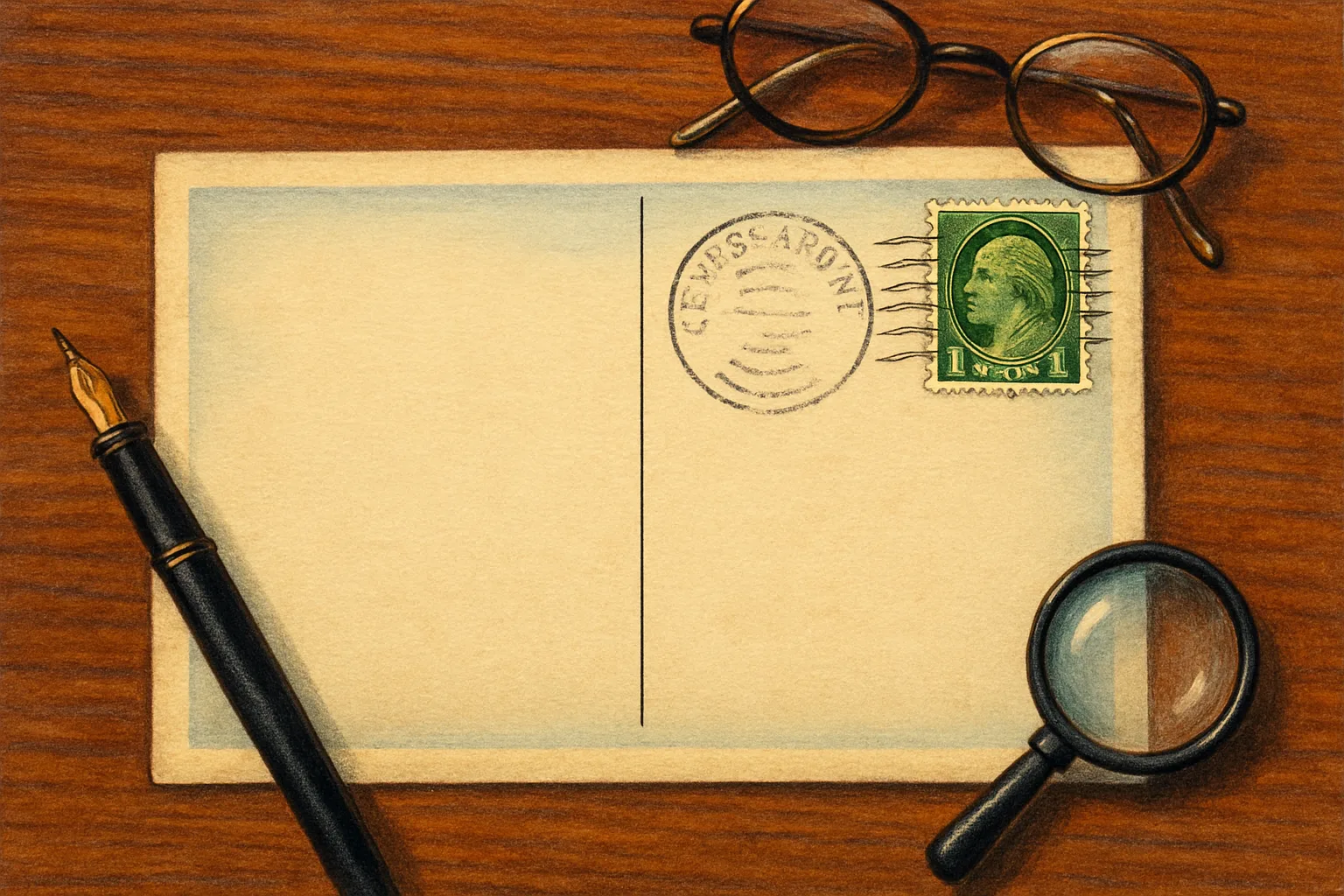
Turn an old postcard over and you'll find a small record of a real moment: a person, a place, a stamp, a date, and sometimes the route the card took to get where it was going. For dating a card, researching a family or just understanding how ordinary Americans used the mail a century ago, the address side is often the most useful part of the card.
This post walks through what to look for on the back of a card mailed between about 1900 and 1920, the busiest years of the American postcard. Some of it overlaps with my guide on how to read a postmark, which covers cancels in more depth. Here the focus is on everything else: how people addressed their mail, what the stamp and rate can tell you, and the small marks that show a card's journey.
First, what kind of back is it?
Before reading the address, look at the layout of the back. It tells you which postal rules the card was printed under.
- Private mailing cards (1898 to 1901) carry the words "Private Mailing Card," often with a line about the Act of Congress of May 19, 1898.
- Undivided backs (1901 to 1907) say "Post Card" but have no dividing line. The rules reserved this whole side for the address, and many cards say so in print, with wording such as "This side is exclusively for the address."
- Divided backs (from March 1, 1907) have a line down the middle, with the message on the left and the address on the right.
My guide on how to date an old postcard explains the full sequence. For reading the address side, the important point is that on an undivided back, the message isn't on the back at all.
Messages on the front of undivided backs
Between 1901 and early 1907, anyone who wanted to say more than a name and address had to write on the picture side. Writing on the address side could get a card treated as a letter rather than a postcard. So people squeezed their words into whatever space they could find.
Publishers knew this, and many cards from these years leave a blank strip beside or below the picture for a note. Where they didn't, writers filled the sky, the margins, the edge of the street, or the space between buildings. You'll see:
- A few words in tiny handwriting along the bottom edge.
- A message written sideways or upside down to fit the space.
- Notes written right across the picture, sometimes through a building or over a face.
Collectors are divided about writing on the front. Some prefer clean pictures, and writing across the image can lower a card's appeal. But on an undivided back it's also a period feature, evidence that the card was used exactly as it was meant to be. Writing on the front of a divided-back card is less expected, and usually just means the writer ran out of room.
How people addressed mail around 1900 to 1920
No ZIP codes, few house numbers
There were no ZIP codes. Large cities got two-digit postal zone numbers in 1943, and the five-digit ZIP code began on July 1, 1963. Today's two-letter state abbreviations were settled in October 1963. So an address like "Chicago 15, Ill." points to the zone era, and an address with a ZIP code is from 1963 or later. On cards before 1943, you won't see either.
In big cities, house numbers and street names were standard. In small towns, many addresses were just a name, a town and a state. The local postmaster or carrier knew everyone, and that was enough.
State and county names
State names were abbreviated in many different ways: "Mass.," "Penn." or "Pa.," "Wis.," "Ia.," "Cal.," "Colo.," "Mich." and so on, often with a period and sometimes spelled out in full. Writers in small towns often added the county as well, as in "Jackson Co." That helped the mail find the right office when several towns in a state shared a name, and it's a gift to researchers today.
R.F.D. routes
Rural Free Delivery began as an experiment on October 1, 1896, around Charles Town, Halltown and Uvilla, West Virginia, and became a permanent service on July 1, 1902. Before that, farm families had to go to the post office for their mail. With RFD, a carrier brought it to the family's mailbox.
On the address side, RFD shows up as "R.F.D. No. 2," "R.F.D. 4," "Rural Route 1" or "R.R. 3," usually after the person's name and before the town. The town is the post office the route ran out of, not necessarily the nearest village. An RFD address tells you the person lived in the country, and it suggests a date after the route was established. For family research it's a useful pointer to a rural household served by a particular office.
General delivery
Some cards are addressed to "General Delivery" or "Gen. Del." That meant the post office held the card until the addressee came in to collect it. It was used by travelers, people who had just moved, workers who followed seasonal jobs, and anyone without a fixed address. A card to general delivery in a city often suggests someone who was passing through or newly arrived.
Post office boxes
"Box 47" or "P.O. Box 112" means the addressee rented a box at the post office. In towns without carrier delivery, a box was the main alternative to collecting mail at the window.
"City" and local mail
Many cards are addressed with a name, a street and simply the word "City" where the town should be. That was a common shorthand for a card mailed to someone in the same town as the sender. The postmark on such a card should be from the same town as the addressee, which makes it a handy check.
Names and titles
Address conventions of the time can tell you a good deal about the people involved:
- "Mrs. John Smith": married women were usually addressed by their husband's name. This can hide a woman's own first name, which is worth knowing if you're tracing her.
- "Miss": an unmarried woman or girl.
- "Master": a young boy. "Mr." was for adult men.
- "c/o" or "in care of": the card went to someone at another person's address, a hotel, a business or a school.
- Family addresses: "Mr. and Mrs. ..." or "The ... Family" are common on holiday cards.
My post on postcards and genealogy goes further into using these clues in family research.
Handwriting conventions
Handwriting on cards from this period is often more formal than modern handwriting, because penmanship was drilled in schools. Ornate, slanted script styles were common, and so were the more practical business hands that schools increasingly taught in the early twentieth century.
A few practical notes for reading them:
- Pencil or ink? Many cards were written in pencil, which has often smudged or faded. Fountain pen ink can fade to brown.
- Capital letters. Old-fashioned capitals, especially S, L, F, T and the long-tailed J and I, are the hardest letters for modern readers. Compare them with the same letter elsewhere on the card.
- Abbreviations. Writers used "Rec'd" for received, "Yrs." for yours, "inst." for this month, "ult." for last month, and abbreviations of names such as "Wm." for William, "Chas." for Charles, "Jas." for James and "Geo." for George.
- Dates. Writers often dated the message themselves, sometimes with a weekday. That date can confirm or fill in a faint postmark.
- Missing names. Many messages are signed with a first name, a nickname or an initial. Combined with the address, that can still be enough to trace a family.
When I list a card, I transcribe the message as written, including spelling, and mark anything I can't read as uncertain rather than guessing.
Stamps and rates
The stamp is a quick check on the date and on whether the card was mailed domestically or abroad. For most of this period a postcard mailed within the United States cost one cent. The exception was the wartime increase: from November 2, 1917 to July 1, 1919, the domestic rate was two cents. My post on the penny postcard has the full rate table.
Things to notice:
- A one-cent stamp is what you'd expect on a domestic card from 1898 to 1917, and again from July 1919. Green one-cent Benjamin Franklin stamps appear on enormous numbers of cards from these years.
- Two cents on a domestic card points to the 1917 to 1919 wartime rate, or to the brief period from 1925 to 1928 when private postcards needed two cents.
- A one-cent stamp plus a second one-cent stamp may be a sender making up the new rate in 1917 or 1918.
- Two cents on a card to another country was the usual international postcard rate, so a two-cent stamp can simply mean the card went abroad.
- No stamp, or a short-paid card, may show a "Postage Due" marking.
- Postal cards, printed by the government with the stamp already on them, need no adhesive stamp. Their printed stamp design can itself be dated.
Stamps can also be missing because someone removed them. A clean rectangle or torn spot where a stamp should be is common on cards from old albums. It's worth noting, but don't take it as evidence that the card was never mailed. The postmark usually tells you whether it was.
Forwarding marks
People moved, and their mail followed them. A forwarded card usually shows:
- The original address crossed out or left in place.
- A new address written beside it, often in a different hand, sometimes by the postmaster.
- Words such as "Forwarded," "Fwd." or "Please forward," or a printed forwarding handstamp.
- A second postmark from the office that sent it on.
As far as I can tell from the postal rules of the time, prepaid first-class mail, including postcards, was generally forwarded without extra postage. A forwarded card is a small story in itself: someone was traveling, had moved for work, or was away at school, and the card chased them across the map.
For family researchers, the second address can be the most useful line on the card. It may show where a person lived for only a short time, a place that doesn't appear in a census.
Receiving marks
On many cards from the early 1900s, the destination post office added its own postmark when the card arrived. Collectors call these receiving marks, or backstamps. On a postcard, with no envelope back to strike, they often landed on the picture side or across the message.
A receiving mark tells you two things: that the card arrived, and roughly how long it took. Cards between nearby towns often arrived the same day or the next. Cards that crossed the country took several days. Receiving marks are common on cards from the first decade of the century and less common later.
Advertising and slogan cancels
In city post offices, machine cancels sometimes carried slogans or pictures instead of plain wavy lines. The 1901 Pan-American Exposition in Buffalo was promoted through special cancellations, including some of the earliest American slogan cancels, and later cancels advertised other fairs, events and postal services.
A slogan cancel can help date a card, since many were used only for a set period, and it can tell you which city's post office handled it. My post on postcards of American world's fairs and expositions covers exposition cancels in a little more detail.
Putting the clues together
Each detail on the address side narrows the picture. Read them in order and combine them with what you can learn from the front:
- Back design: gives a broad printing window.
- Postmark date: the date the card was mailed, and the latest it could have been printed.
- Stamp and rate: confirms the date and shows whether it went abroad.
- Address form: RFD, general delivery, a zone number or a ZIP code each point to a period.
- Forwarding and receiving marks: show the card's route and timing.
- The message: dates, weekdays, seasons, events and names.
Here's how that works in practice. A divided-back card with a one-cent stamp, addressed to an R.F.D. route and postmarked in 1910, was printed between March 1907 and 1910 and mailed to a rural household. A card with two cents in stamps, postmarked 1918, was paying the wartime rate. A card addressed "Chicago 15, Ill." and no ZIP code was most likely mailed between 1943 and 1963, whatever the picture looks like.
Caring for the address side
The address side is part of the card's history, so treat it with the same care as the picture. Don't erase pencil, don't try to lift stamps, and don't add your own notes in ink. If you need to label a card, put the label on its sleeve. My guide to storing old postcards covers the details, and my guide to real photo postcards explains how the stamp box on a photo card adds another dating clue.
Why it's worth the time
A picture postcard shows a place. The address side shows a life touching that place, if only for a moment. A farm family on a rural route, a young man at general delivery in a new city, a card forwarded twice to catch up with someone who'd moved: these are the small, real details that history books leave out. When I research a card, the back is where I start, and it's often where the most interesting part of the story turns out to be.