When I pick up a real photo postcard of a tiny town, a muddy main street, a one-room school, a crossroads store with a dog asleep on the porch, I always wonder who stood behind the camera. Often there's no name on the card at all. Sometimes there's a studio stamp, a set of initials scratched into the negative, or a number in the corner. Either way, somebody carried a heavy camera to that spot, made the exposure, developed it, printed it on postcard paper and found a way to sell it.
A lot of those somebodies were traveling photographers. This post is about them: the technology that made their trade possible, how they worked and sold their cards, and why their pictures matter so much now.
The technology: postcard paper and a postcard camera
Two products from Eastman Kodak opened the door.
Paper with a postcard back
In 1902 Kodak began selling photographic paper with a postcard back already printed on it. A photographer could print a negative directly onto a sheet that was, once trimmed, a ready-to-mail postcard. No gluing, no mounting, no printing press. Other paper makers followed with their own postcard stocks, and the brand names printed in the stamp box, such as AZO, Velox, CYKO and many more, are now one of the best ways to date a photo card. My guide to real photo postcards covers the main stamp boxes and their approximate date ranges.
The No. 3A Folding Pocket Kodak
In 1903 Kodak introduced the No. 3A Folding Pocket Kodak, which made negatives about 3¼ by 5½ inches on roll film. That's postcard size. A negative from a 3A could be contact printed straight onto postcard paper, with no enlarger needed. The camera folded into a reasonably portable case, which mattered a great deal to anyone moving from town to town.
The 3A went through many versions over the following years. It wasn't the only option, though. Many professionals kept using view cameras and glass plates, which gave fine detail and could be cropped to fit the postcard format.
Kodak's own service
By 1907 Kodak was also offering a service that turned an amateur's snapshots into postcards. That helped make photo postcards something families made themselves: new babies, new houses, the family car, the farm. A good share of the real photo cards that survive are this kind of personal picture. The rest, especially the street scenes and town views, tend to be the work of professionals.
Who the traveling photographers were
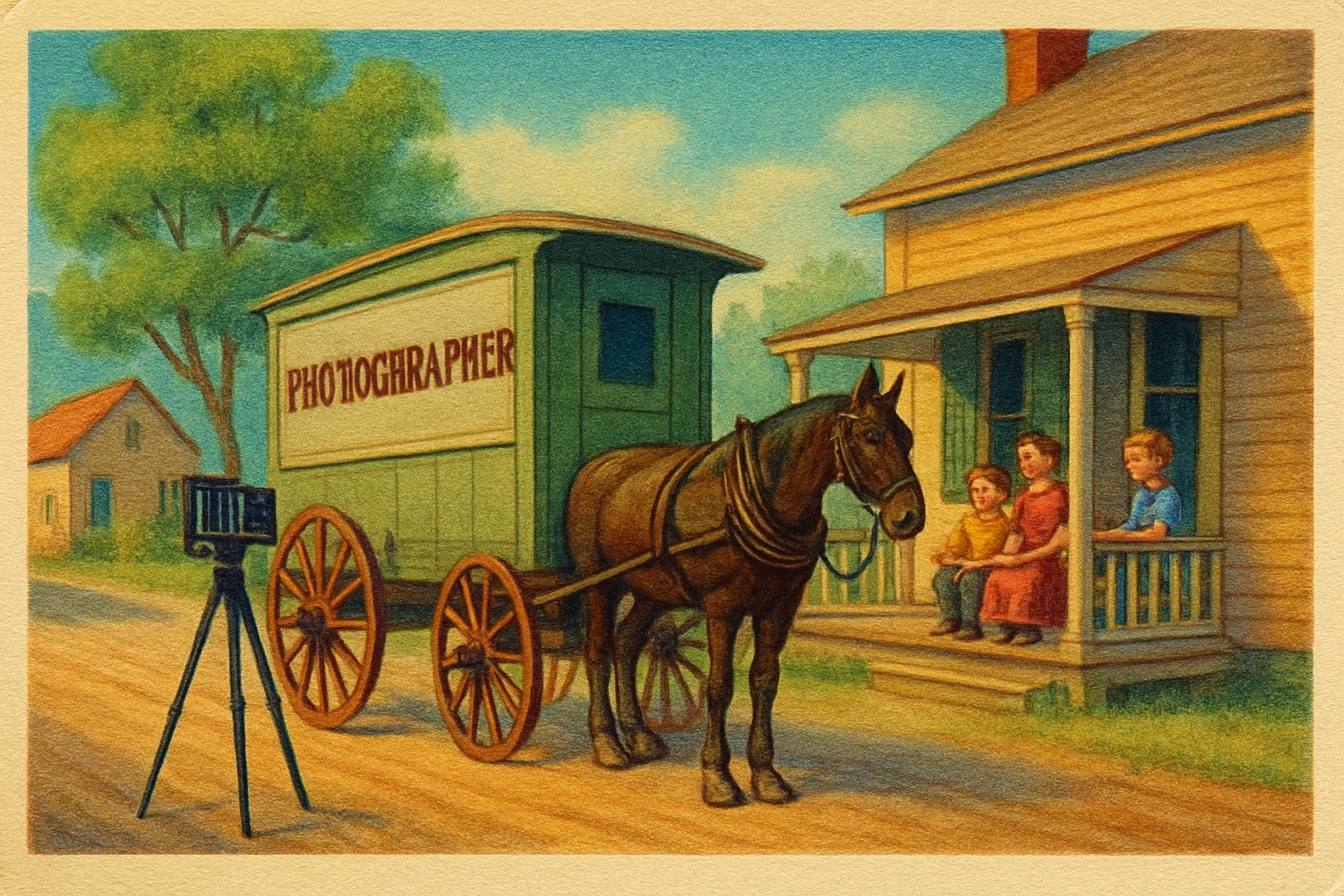
The honest answer is that most of them are anonymous now. A real photo postcard was a cheap, everyday product, and plenty of photographers never put their names on the cards. Some ran a studio in one town and made trips to nearby villages. Some worked a region by wagon, by train, and later by car. Some worked for companies that sent photographers out on the road.
A well-documented example: Eastern Illustrating & Publishing
The best-documented traveling operation I know of is the Eastern Illustrating & Publishing Company of Belfast, Maine. It was started in 1909 by Herman Cassens and ran until 1947. Accounts of the company describe Cassens sending a handful of photographers out each spring to work through the summer, traveling the small towns and tourist spots of New England and New York. The exposed glass plates were shipped back to Belfast, where the cards were made, and the finished postcards were sold through local stores such as general stores in the towns that had been photographed.
The company's glass plate negatives are now held by the Penobscot Marine Museum in Searsport, Maine. Published counts vary depending on the source and the date, but they run to tens of thousands of plates. It's one of the largest surviving records of small-town New England in the first half of the twentieth century, made by people whose job was to photograph places that few others bothered to.
I mention this company because it's documented. For the many other photographers who worked the same way, the paper trail is thin or missing, and I'd rather not attach a name to work unless the evidence supports it.
How a traveling photographer worked
Details varied from person to person, but the general pattern was simple.
- Arrive in town. Many photographers chose places that had no regular postcard supply, or where local views had gone out of date.
- Photograph the sights. The main street, the church, the school, the mill, the depot, the town hall, the view from the hill. Anything a resident or visitor might want to mail.
- Take commissions. A merchant might pay for a picture of his store with the staff lined up outside. A family might want their house. A lodge or a team might want a group portrait.
- Cover events. Parades, fairs, floods, fires and train wrecks sold quickly, because everybody wanted a picture.
- Develop and print. Some photographers worked in a temporary darkroom on the road. Others sent the negatives home to a studio or company plant, as Eastern Illustrating did.
- Caption the cards. Captions were often written or scratched backward on the negative, so they printed as white letters on the picture. Many also carry a number, which was the photographer's way of keeping track of negatives for reorders.
- Sell and move on. Cards went to local shops, and the photographer went on to the next town.
Captions are clues
The handwritten caption on a real photo card is worth studying. It tells you how the place was named at the time, and the style of handwriting and numbering can sometimes link cards to the same maker. Two cards from neighboring towns with the same lettering, the same style of number and the same paper are very likely the work of one photographer, even if neither card carries a name.
How the cards were sold
Real photo postcards were sold in the same places as printed cards: drugstores, stationery shops, general stores, hotels and post office counters. In a small village, the general store was often the only outlet, and it might stock a handful of local views from a single photographer.
The economics depended on quantity being small but turnover being quick. A photographer didn't need to sell thousands of copies of any one view. A few dozen of each, across a dozen views, in each of many towns, added up. Event photographs could sell fast, because everyone in town wanted a picture of the flood, the fire or the parade while it was still the talk of the neighborhood.
That small-batch model is exactly why these cards are scarce today. A printed card of a popular resort might have been run off by the thousand in Germany or Chicago. A real photo view of a hill village might have been printed in a couple of dozen copies, many of which were mailed, lost, damaged or thrown away.
A look at two Vermont examples
I have two real photo postcards of Williamsville, Vermont, a small village in the town of Newfane, and neither carries a photographer's name.
One is captioned "The Old Mill, Williamsville, Vt." It shows still water in front of a mill building among trees on a rocky bank, with a stack and what looks like steam or smoke. It has a divided back with a CYKO stamp box, which points to roughly 1904 to the 1920s, and it was never mailed.
The other, captioned "Williamsville, Vt.," is a general view of the village across a field, and it was mailed from Brattleboro in May 1909.
I can't tell you who took either picture. They might be the work of a Brattleboro studio, a traveling photographer, or a talented local amateur. What I can say is that somebody thought a small mill village was worth photographing and selling, and that the cards survived. That's typical of real photo work: the picture outlives the photographer's name.
Why their work matters today
It's easy to think of these photographers as minor commercial figures, and in their own time they mostly were. But their work has become far more important than anyone expected.
They photographed what nobody else did
Newspapers rarely sent photographers to tiny villages, and the big printed postcard publishers concentrated on places with lots of buyers. Traveling photographers went everywhere. For many small towns, their cards are the earliest or only photographs of particular buildings and streets.
They recorded change
Mills that later burned or were washed out, stores that closed, schools that were torn down, covered bridges that were replaced: real photo cards often catch these places at a specific moment. Local historical societies use them to date buildings and reconstruct streetscapes.
They captured everyday people
Because photographers took commissions and covered local events, real photo cards are full of ordinary people: shopkeepers, schoolchildren, farm workers, families on their porches. For family historians, a card can be the only known photograph of an ancestor's house or business. My post on postcards and genealogy has more on that.
The quality is often excellent
A contact print from a large negative can be astonishingly sharp. Under magnification you can sometimes read signs in shop windows or the names on wagons. That level of detail is part of what makes good real photo cards so rewarding to study.
What to look for on a card
If you want to learn more about the maker of a real photo card, here's what I check:
- A studio stamp or imprint on the back, sometimes in small type along the edge.
- A name, initials or a number scratched or written into the negative on the front.
- The paper's stamp box, which helps with dating.
- The caption's handwriting, for comparison with other cards from the area.
- The postmark, if it was mailed, which shows where and when the card was in circulation. My guide on how to read a postmark explains the details.
And if you're deciding what such a card might be worth, subject and location usually matter most. My guide to what makes a postcard valuable explains why a sharp real photo of a small-town main street can be worth far more than a printed view of a famous landmark.
The camera on the back road
I like to picture the traveling photographers at work: unloading a camera and tripod at the edge of a field, waiting for the light, taking a few exposures, then packing up and heading for the next town before the roads got dark. They weren't trying to make history. They were trying to make a living, a nickel or a dime at a time. But because they went down the back roads, a great deal of small-town America was photographed that otherwise never would have been.
Every unnamed real photo card is a small piece of their work. When one of them turns up in a box of old postcards, it's worth looking closely, both at what's in the picture and at the clues to who made it. You can find more about how I research cards on my about page.