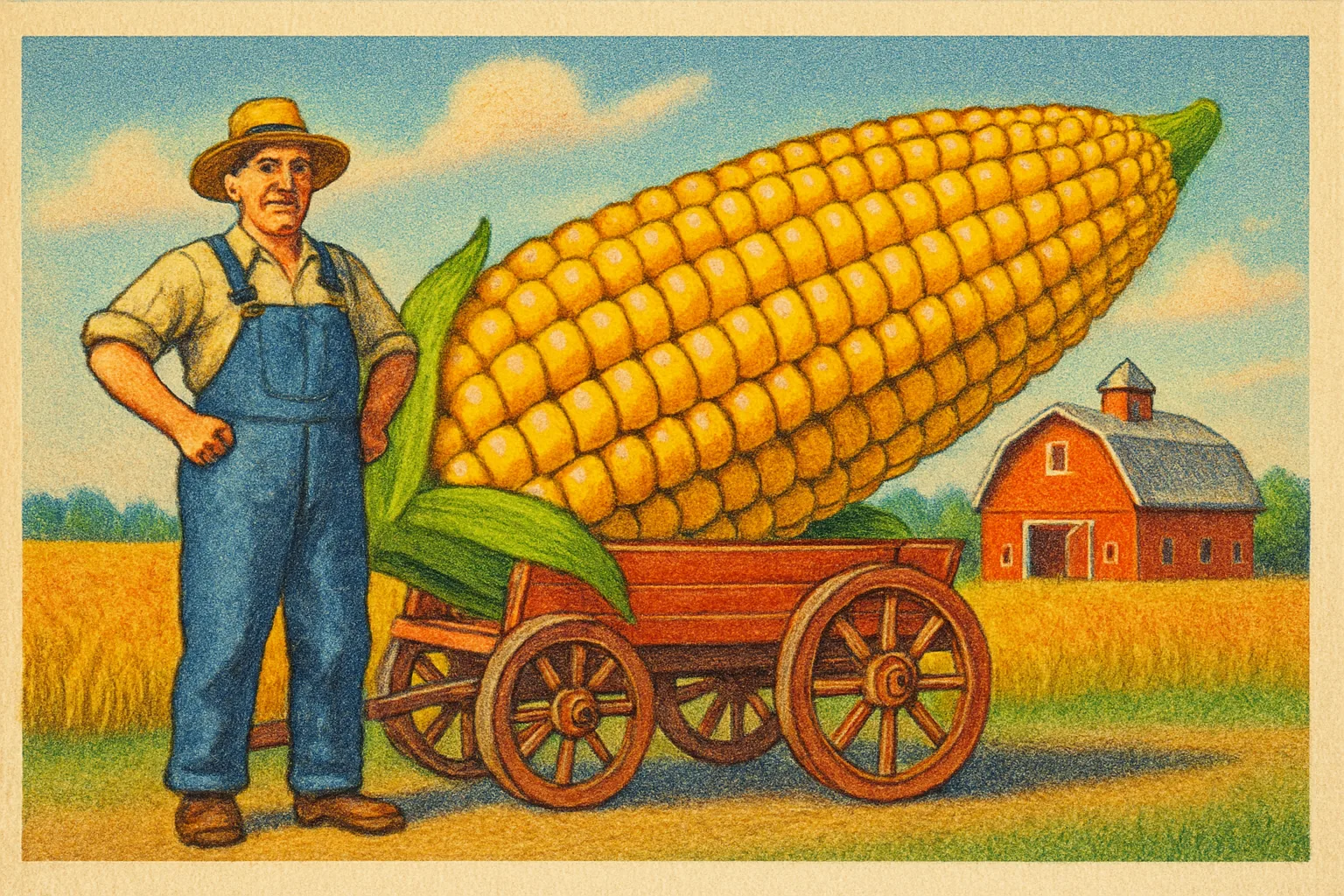
Some old postcards ask you to believe them. Exaggeration postcards dare you not to laugh. They show farmers dwarfed by potatoes, hunters riding jackrabbits the size of horses, and wagons loaded with a single enormous peach. Collectors also call them tall-tale cards, and some of the photographers who made them called them "freak" or "novelty" cards.
They're one of the most cheerful corners of postcard collecting, and also a surprisingly rich one. Behind the jokes is real photographic skill, a strong regional identity, and a lot of commercial savvy. This post covers where the cards came from, the photographers best known for them, how the trick worked, and what to look for if you want to collect them.
What an exaggeration postcard is
An exaggeration postcard is a photograph, or a printed card made from one, that has been altered so that something ordinary appears absurdly large. The usual subjects:
- Crops: corn, potatoes, onions, apples, peaches, melons, wheat and pumpkins.
- Game and fish: rabbits, ducks, geese, bass, trout and pike.
- Pests: grasshoppers above all, which became a famous subtheme on the Great Plains.
- Livestock and poultry: chickens, hogs and the occasional enormous cow.
The joke usually lands through the caption as much as the picture. A wagon carrying one apple might be titled with something matter-of-fact about "a load of our apples," or a car chasing a giant rabbit might say that when people in a certain state go after something, they get it. The deadpan voice is the point.
The book most often cited on the subject, Larger Than Life: The American Tall-Tale Postcard, 1905-1915, with text by Cynthia Elyce Rubin and cards from the collection of Morgan Williams, was published by Abbeville Press in 1990. Its title gives the span that most collectors think of as the heyday, though exaggeration cards were made before and long after.
Why the early 1900s
Three things came together in the first decade of the twentieth century.
First, the postcard itself exploded in popularity. After the divided back was allowed in March 1907, Americans mailed cards in enormous numbers, and publishers were hungry for subjects that would sell. Billions of cards went through the American mail in those years.
Second, real photo postcards made it practical for a small-town photographer to produce cards in quantity. Photographic paper with a postcard back already printed on it meant any studio could turn a negative into sellable postcards. My guide to real photo postcards explains how they were made and how to recognize them.
Third, the tall tale was already part of American humor, especially in the West and on the farm frontier. The exaggeration postcard took that spoken tradition and put it into a photograph, which made the joke all the funnier because photographs were still widely trusted as records of fact.
How the trick was done
Most exaggeration cards were composites. The Kansas Historical Society describes the basic method:
- The photographer made two black-and-white photographs: a wide shot of the scene, such as a farmer with a wagon, and a close-up of the "star," such as an ear of corn or a fish.
- The close-up was enlarged and printed.
- The enlarged subject was carefully cut out and glued onto a print of the wide shot, in place.
- The paste-up was then retouched, so that edges, shadows and lighting matched as well as possible, and rephotographed to make a new negative from which the postcards were printed.
The Wisconsin Historical Society holds photographic mock-ups made for this kind of photomontage, which shows how much handwork went into each image. The best makers were skilled at matching light direction, perspective and scale, so the absurd object seems to sit in the scene. Weaker examples have obvious cut lines, mismatched shadows or a subject that floats.
That handwork is part of what collectors admire. Long before digital editing, these photographers were making convincing composite images with scissors, glue, a retouching brush and a copy camera.
The photographers
Many studios across the country made exaggeration cards, and many cards carry no maker's name at all. A few photographers stand out in the record.
William H. "Dad" Martin, Ottawa, Kansas
William H. Martin (1865 to 1940) is the name most collectors know first. He took over a photography studio in Ottawa, Kansas, in 1894, and around 1908 began experimenting with trick photography. The results sold so well that he set up the Martin Post Card Company in 1909, and the Kansas Historical Society reports that the firm reportedly produced seven million cards in 1910. That figure has been repeated widely, so I give it as a reported number rather than a firm count.
Martin's subjects included giant ears of corn, huge peaches, monster bass, ducks and geese, and rabbits so large they were hunted by automobile. His work is technically polished, and he's generally considered the best of the exaggeration photographers. In 1912 he sold the postcard business; it moved to Kansas City as the North American Post Card Company, and Martin went on to found a sign company in Ottawa.
Alfred Stanley Johnson Jr., Waupun, Wisconsin
Alfred Stanley Johnson Jr. worked in the family photography studio in Waupun, Wisconsin, which his father had started in 1884. In late October 1909 he copyrighted his first exaggeration card, a giant carp said to have been caught in Beaver Dam Pond. Most of his tall-tale cards date from 1909 to about 1913, though he made them into the early 1920s, and many carry his signature heading, "How We Do Things in" or "at" a particular town.
Researcher Joyce M. Tice catalogued more than a hundred of Johnson's cards, and the Wisconsin Historical Society holds a collection of his work. His subjects range from giant vegetables to fishing and hunting scenes and other jokes, and they offer a Midwestern counterpart to the Kansas cards.
Frank D. "Pop" Conard, Garden City, Kansas
Frank D. Conard belongs to a later chapter. When a swarm of grasshoppers descended on Garden City, Kansas, in 1935, Conard, a skilled retoucher, made montages of enormous grasshoppers with people: insects fighting a man, filling the bed of a pickup truck, holding up a train. He described them as a joke rather than a slight on Kansas, and the Kansas Historical Society reports that he kept printing his "hopper whoppers" until he retired in 1963. Rabbit cards with his credit line are also held by the Nebraska State Historical Society.
Conard's work shows that the genre outlived the postcard craze by decades, and that the humor could turn hard times, not just good harvests, into a laugh.
Many others
Plenty of other photographers and publishers made exaggeration cards in many states, especially across the Midwest and the Plains. Many are unidentified or known only by a credit line on a handful of cards. Research by geographer Jason Combs and his son Tate, published in Nebraska History Magazine in 2019, looked at Nebraska's exaggeration cards and found that most date from roughly 1905 to 1920.
Boosterism and the joke
On one level, exaggeration cards are pure fun. On another, they're advertising.
The early 1900s were the tail end of the great settlement of the Plains, and towns and states competed for settlers, investors and railroad traffic. Boosters published pamphlets praising the soil and climate. Exaggeration postcards did the same job with a wink. The Kansas Historical Society notes that the cards' pictures of fertile land promoted the prosperity that drew settlers to Kansas. The Nebraska research finds the cards promoting the state's natural bounty and its commodities, even during periods of drought, low prices and grasshopper plagues.
That's why so many captions name a place. "Our state," a particular town, or a state abbreviation turns the gag into a boast. Collectors find the same scene used with different place names in its caption, which suggests that some photographers sold their images to dealers in many towns, each of whom wanted the boast to be about home.
There's a gentle irony in this. The cards that bragged about giant crops were mailed from places where farming was hard and uncertain. The humor sits right next to the worry. Many of the messages on the backs, about the weather, the harvest and the prices, make that clear.
How to collect exaggeration postcards
Decide what you want
Exaggeration cards can be organized several ways:
- By photographer: Martin, Johnson, Conard and other identified makers.
- By subject: corn, fish, rabbits, grasshoppers, and so on.
- By state or town: cards whose captions name a particular place, which appeal to local history collectors as well.
- By format: real photo cards versus printed cards made from the same images.
Real photo or printed?
Many of the best-known exaggeration images were issued as real photo postcards, and some also appear as printed cards. Under a magnifier, a printed card shows a dot pattern or other printing texture, while a real photo shows continuous tone with no dots. The stamp box on a real photo card, printed by the maker of the photographic paper, can also help date it. My guide on how to date an old postcard explains how to use those clues along with the back design and postmark.
Look at the craft
The quality of the composite varies enormously. Clean edges, matched shadows and a believable sense of scale are the marks of a skilled maker. Crude paste-ups have their own charm, but most collectors prize the well-made ones.
Read the caption and the credit line
Many cards carry a copyright line, a studio name or a series number, often written or scratched into the negative and visible along the bottom of the picture. These are the best evidence for who made a card. Be careful about attributing an unsigned card to a famous maker just because it resembles their work.
Check condition
As with any card, corners, creases, surface wear and fading matter. Real photo cards can silver, fade or develop a mirrored sheen in dark areas over time. A clear image with good contrast is what you want. My guide to what makes a postcard valuable covers how condition, subject and scarcity combine.
Watch for modern copies
Exaggeration images are popular, and modern reprints and copies of famous examples are common. A copy printed from a scan won't have the continuous tone of a real photo, and the paper and back will be wrong for the period. My notes on how to spot a reproduction postcard explain what to check. If a "1909" Martin card looks too crisp, too white and too uniform, look closer.
Caring for them
Real photo exaggeration cards are photographs, and they are sensitive to light, heat and humidity. Keep them in archival, acid-free sleeves and store them flat in a cool, dark, dry place. Don't display originals in direct sunlight. My guide to storing old postcards has the details.
Why they still work
The funny thing about exaggeration postcards is how well they've held up. The jokes are more than a century old and still land. Part of that is the deadpan delivery, and part of it is the skill: in an age that was still learning to trust photographs, these photographers were already having fun with how easily a picture can fool the eye.
They also hold a real piece of rural history. Behind every giant potato is a town that wanted to be noticed, a photographer trying to make a living from a small studio, and a farm family hoping next year's crop would be good. The traveling photographers who made real photo views of small towns, covered in my post on traveling real photo photographers, worked in the same world and the same years. The exaggeration photographers simply decided that the truth could use a little help.