The phrase "penny postcard" survives in everyday speech long after the price disappeared. For most of the years between the 1870s and 1951, mailing a postcard inside the United States cost one cent. That small number shaped the whole culture of the postcard: how people used them, what they wrote, and even how the cards were designed.
It also left a trail of evidence on every card that went through the mail. The stamp in the corner, and the rate it paid, is one of the clues I use to date cards. This post covers the rate history, how a penny changed the way people wrote, and what the stamp can tell you.
The rate history in one table
The dates below come from the postal service's published history of postcard rates. Note the difference between two kinds of card: stamped cards (often called postal cards) printed by the government with the postage already on them, and postcards printed privately, which needed a stamp.
| Effective date | Rate | What changed |
|---|---|---|
| May 1873 | 1 cent | Government stamped postal cards introduced at one cent |
| July 1, 1898 | 1 cent | Privately printed cards allowed the same one-cent rate |
| November 2, 1917 | 2 cents | Wartime increase |
| July 1, 1919 | 1 cent | Back to a penny |
| April 15, 1925 | 1 or 2 cents | Stamped cards stayed at 1 cent; private postcards went to 2 cents |
| July 1, 1928 | 1 cent | Private postcards back to a penny |
| January 1, 1952 | 2 cents | The end of the penny postcard |
| August 1, 1958 | 3 cents | Rates begin climbing more often |
That 1925 to 1928 split is the one that surprises people. For a little over three years, a government postal card still went for a penny, but a picture postcard from a drugstore rack needed two cents.
Before 1898: the government's card and everyone else's
The government postal card arrived in 1873, a plain card with the stamp printed on it. It was cheap and practical, but it had no picture, and the government had the penny rate largely to itself.
Privately printed cards existed, including some early picture cards, but in general they had to pay the letter rate. That made them a poor bargain, and it's one reason picture postcards from before 1898 are scarce in the United States.
1898: the Private Mailing Card Act
An Act of Congress dated May 19, 1898 changed that. From July 1, 1898, private publishers could print cards that traveled at the one-cent rate, as long as the back carried the words "Private Mailing Card." Many also printed the line "Authorized by Act of Congress, May 19, 1898."
If you find those words on a card, you're holding something from roughly 1898 to 1901, the opening years of the picture postcard in America. From December 24, 1901, publishers could use the shorter words "Post Card," but the back was still reserved for the address alone until March 1, 1907, when divided backs arrived. My guide on how to date an old postcard explains each of these back styles with examples.
How a penny shaped the message
A letter in these years generally cost two cents and came with expectations. You needed paper, an envelope and, by the manners of the day, something worth saying. A postcard cost half as much to mail, needed nothing extra, and carried no obligation to be long or polished.
The result was a different kind of writing. Read a few hundred golden-age postcards and some patterns jump out.
Short, practical news
Most messages are a few lines: arrived safely, coming Tuesday, will meet the 4:15, the cold is better. The postcard was a quick note, and people treated it like one.
Constant weather
Weather is the single most common subject I see. It was safe, universal and important, especially to rural writers whose work depended on it. Rain, a late spring, a heat wave, deep snow: the penny postcard is an enormous informal weather diary.
A shared picture
Because the card had a picture, writers pointed to it. An X over a window, a penciled note naming the church or the house, a note that the photographer caught the house just right. The picture did some of the talking, which meant the message could be shorter.
Openness, with limits
Everyone knew a postcard could be read by the mail carrier, the postmaster and anybody at home. People still wrote personal things, but serious or private news tended to go in a letter. Some writers used initials, nicknames or the occasional joke in code to keep things private.
Writing on the front
Before 1907, because the back was for the address only, people squeezed messages onto the picture side. That's a direct effect of the rules, not of carelessness. If you see a crowded front with tiny handwriting in the sky, check the back; it's probably undivided.
The war rate: 1917 to 1919
On November 2, 1917, as part of wartime revenue measures, the postcard rate doubled to two cents. It returned to one cent on July 1, 1919.
Those twenty months leave a recognizable mark on cards. During the war rate you'll see:
- Cards with a single two-cent stamp, usually the red Washington stamp of the period.
- Cards with two one-cent stamps side by side.
- Cards printed with a one-cent stamp box but bearing two cents of postage, because publishers didn't reprint their stock.
- Occasionally, cards marked as short paid, where the sender used only a penny.
A two-cent stamp on a card postmarked between late 1917 and mid-1919 is exactly what you should expect. A two-cent stamp on a card from 1912 might mean the sender overpaid, or the card was going abroad. The foreign rate was different, and cards mailed overseas usually carry more postage regardless of date.
The war years changed postcards in other ways too, which I cover in how World War One changed American postcards.
1952: the end of the penny
The one-cent rate came back in 1919, wobbled for private cards from 1925 to 1928, and then held until January 1, 1952, when the rate became two cents. You'll occasionally see 1951 given for this change in older references, but the postal service's own table gives January 1, 1952.
After that, the increases came more often: three cents in 1958, four in 1963, five in 1968, and on up. The age of the penny postcard was over, though the phrase stuck around for decades.
What stamps tell a collector
The stamp is a small part of the card, but it can carry a lot of information. Here's how I read it.
The rate narrows the date
A one-cent stamp on a domestic card is normal for almost everything before 1952, so on its own it doesn't say much. But a two-cent stamp points toward the war rate, the 1925 to 1928 private-card rate, or 1952 and later. Combine that with the back design and the picture style, and the window often closes quickly.
The stamp design narrows it further
Stamp designs changed every few years, and a stamp can't be used before it was issued. A few examples from the golden age:
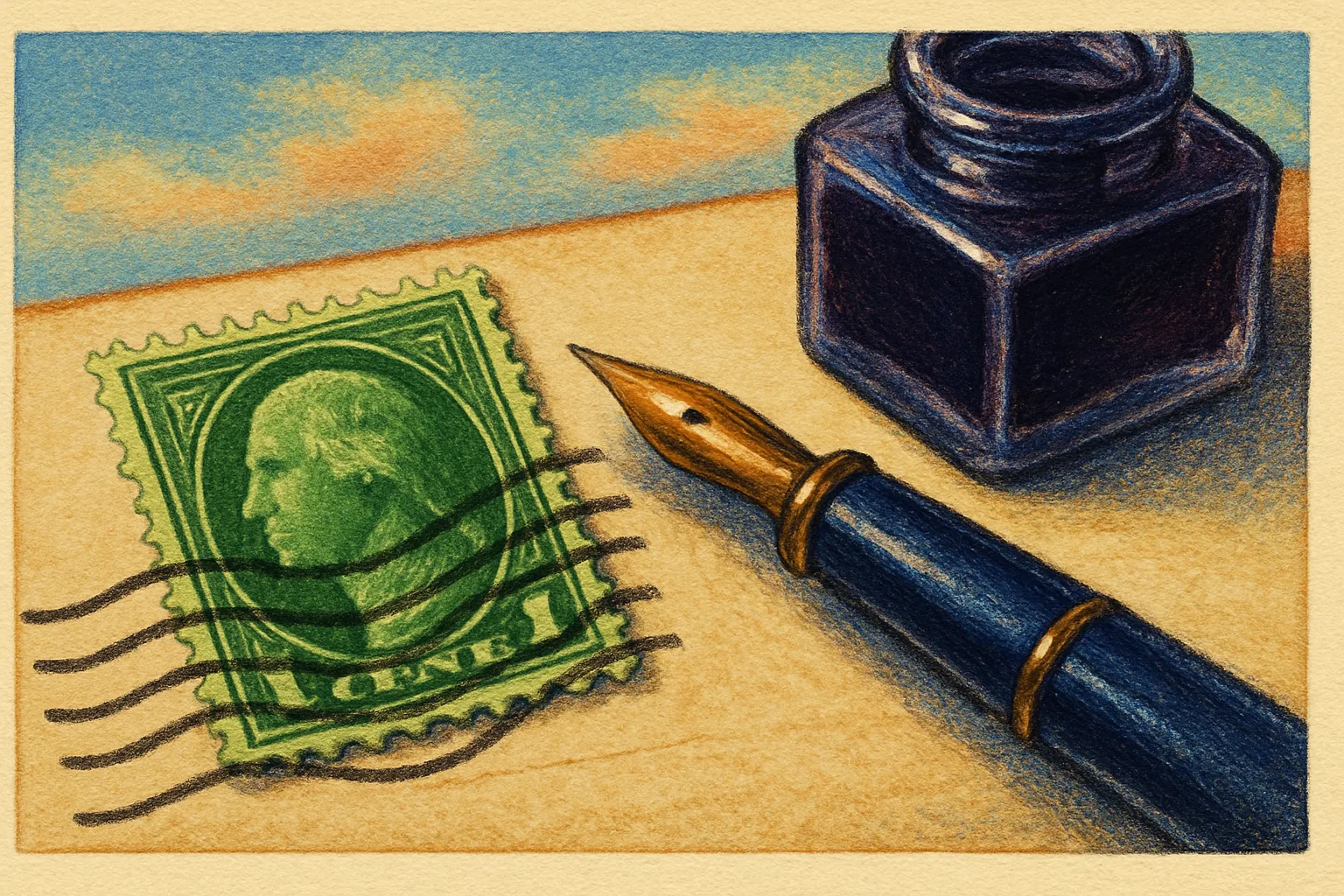
- The 1902 series one-cent Franklin. A green stamp with Benjamin Franklin's portrait, issued in early 1903 even though collectors call it the Series 1902. It paid the penny postcard rate for years, and huge numbers were printed.
- The Washington-Franklin one-cent. From late 1908 a new series appeared, again with Franklin on the green one-cent stamp, in a simpler design. Old stock of the earlier stamp kept turning up for a while after that.
My own card of Williamsville, Vermont, mailed in 1909, carries a green one-cent Franklin from the 1902 series, posted in May 1909. That's a nice example of an older stamp still in use some months after the newer series came out, which was common.
The stamp box tells you about the printer
Most picture postcards have a printed box where the stamp goes, and the wording inside it is a clue in its own right. On printed cards, many publishers put "Place stamp here" along with a reminder of the rate, such as "Domestic one cent, foreign two cents."
My card of the Retreat Tower in Brattleboro, published by Chas. W. Hughes, has a "Domestic one cent" stamp box, which fits a card printed for sale while the penny rate held. On real photo postcards, the stamp box usually carries the name of the photographic paper instead, such as AZO, Velox or CYKO, and that's one of the best dating tools for photo cards. My guide to real photo postcards lists the common stamp boxes and their approximate dates.
The postmark completes the picture
The stamp tells you what was paid; the postmark tells you when and where. A clear town name and date is gold for anyone researching local or family history. Many golden-age cards also carry machine cancels, including the wavy-line flag cancels that decorate so many cards from the period. I go through the parts of a postmark in how to read a postmark.
A word on value
Collectors sometimes assume an old stamp makes a card valuable. Usually it doesn't. Common one-cent stamps of the era were printed in the billions and are worth very little on their own. What makes a card desirable is almost always the picture, the place and the condition, with the postmark and message adding interest. There are exceptions, such as scarce town postmarks or unusual usages, but they're the minority. My guide to what makes a postcard valuable goes into this in more detail.
Please don't soak stamps off old postcards. Removing the stamp damages the card and destroys the connection between the stamp, the postmark and the message, which is where most of the historical interest lies.
Why the penny still matters
The one-cent rate was a policy decision made by Congress and the Post Office, but its effects reached into millions of households. It made the postcard the cheapest way to send a picture and a few words across the country, and it encouraged a casual, chatty style of writing that feels surprisingly modern.
For collectors, it left a set of fingerprints on every card: the stamp design, the rate paid, the wording in the stamp box, and the postmark. Learn to read those, and an anonymous old card starts telling you exactly when it was in somebody's hand. For the next step after the stamp, see my guide on how to read a postmark, which pairs well with the stamp clues above.