If you sort a box of old American view cards by date, something happens around the middle of the 1910s. The cards before it tend to be rich, finely detailed and often marked "Printed in Germany." The cards after it are more often marked "Made in U.S.A.," framed by a plain white border, and printed with a flatter, simpler palette.
That change was not an accident of taste. It came from a tariff fight, a world war that cut off the source of most fine color printing, and a wartime postal rate that briefly doubled the cost of mailing a card. This post traces each of those threads and shows how to spot them on cards you might find today.
The German golden age
During the early 1900s, Germany was the center of fine color printing. German lithographers, particularly in Saxony and Bavaria, had the skilled workforce, presses and techniques to produce inexpensive cards with deep colors, embossing and metallic finishes. American publishers sent photographs and artwork across the Atlantic and received finished cards in return.
The imprint tells the story. Look on the back or along the bottom edge of a card from those years and you will often find "Printed in Germany," "Made in Germany," or a more specific "Printed in Saxony" or "Printed in Bavaria." Large publishers such as Raphael Tuck & Sons, based in London, contracted much of their color work to German printers. The American firm International Art Publishing Company did the same; its leading artist, Ellen Clapsaddle, spent time in Germany working directly with the engravers who produced its cards.
I have not found a reliable figure for exactly what share of American cards came from Germany, so I won't put a number on it. What is clear from the cards themselves, and from histories of the trade, is that German printers dominated the high-quality end of the market in the years before the war.
This was also the period when Americans mailed postcards in staggering numbers. The craze took off after March 1, 1907, when the United States began allowing messages on the left half of a card's back, creating the divided back.
The Payne-Aldrich Tariff of 1909
The first blow to German cards came from Washington rather than from the war.
American printers wanted a share of the postcard boom, and they argued that a higher duty on imported cards would protect American jobs. Importers who depended on German quality, including International Art Publishing, argued the other way. The domestic printers won. The Payne-Aldrich Tariff Act of 1909 included a much steeper duty on imported postcards. According to the U.S. House of Representatives' history office, the new rate was 15 cents per pound plus 25 percent of the value, far higher than before.
The tariff was meant to help American printers. By most accounts it did not work out that way, at least not at first. American printing of the time generally could not match the German product, and buyers noticed. The House history office notes that the postcard craze began to decline soon after the tariff passed, and it quotes a trade publication of the period blaming the tariff for the failure of hundreds of postcard firms.
Historians weigh several causes for the end of the boom: the tariff, the novelty wearing off, the rise of the telephone and the folded greeting card in an envelope. I think it is fair to say the tariff was one important factor among several, rather than the single cause.
The war cuts the cord
When war broke out in Europe in the summer of 1914, the flow of German printing to the United States was disrupted, and it effectively ended once the United States entered the war in April 1917. Publishers that depended on German suppliers were left without their printers. Some, including the firm associated with Ellen Clapsaddle, did not survive the break. Large amounts of original artwork and printing material in Germany were lost.
American printers, who had been building up capacity since the tariff, filled the gap. Firms such as Curt Teich & Company of Chicago, founded in 1898 by a German-born printer, grew into major producers of view cards. Teich's company would later become famous for its linen cards of the 1930s and 1940s.
The white border era
One of the easiest ways to recognize a postcard from the years around and after the war is the white border. Instead of the picture running to the edges, a margin of plain card frames the image.
The reason most often given by postcard historians is economy: a border saved ink, and printers were working with tighter supplies and costs. It may also have suited the printing methods American firms used, and it became a fashion of its own. Whatever the mix of reasons, white-bordered cards are common from roughly 1915 to 1930, and that border is one of the first clues I check when dating an old postcard.
An example from my own boxes
One of my cards shows this transition well. It is a white border view of Retreat Tower in Brattleboro, Vermont, published by Chas. W. Hughes of Mechanicville, New York, under the name "Star Quality." The back credits the printing to Curt Teich as "C.T. American Art," with the number A-42474. It has a divided back with "Domestic one cent" in the stamp box, and it was never mailed. Everything about it points to an American-made card from about 1913 to 1920: the white border, the American printer, the divided back.
How to tell German from American printing
Side by side, the difference is often visible to the naked eye. Under a 10x magnifier it becomes clearer.
Typical German-printed cards, before the war:
- Imprint reading "Printed in Germany," "Made in Germany," "Saxony" or "Bavaria."
- Rich, layered color with deep shadows and subtle blends.
- Fine detail in architecture and foliage.
- Frequent embossing, gold or silver highlights, and glossy finishes on greeting cards.
- Full-bleed images, often with no border.
Typical American-printed cards, during and just after the war:
- Imprint reading "Made in U.S.A." or naming an American printer.
- A white border around the image.
- Flatter color, often with a visible halftone dot pattern under magnification.
- Less embossing on view cards.
- Some hand-tinted looking colors, with skies and lawns in broad washes.
These are tendencies, not rules. Some American printers produced very good work before the war, and some German cards were plain. Use the imprint first and the look second.
The two-cent postcard, 1917 to 1919
For most of the postcard era, mailing a domestic postcard cost one cent. I wrote about that famous price in the penny postcard. But for a short stretch during and after the war, it doubled.
To help pay for the war, Congress raised postage rates. According to the U.S. Postal Service's own history of postcard rates, the domestic postcard rate went to two cents on November 2, 1917, and returned to one cent on July 1, 1919. Some newspapers of the time gave November 3 as the date, but the Postal Service lists November 2.
This short window gives collectors a handy dating tool.
- A card postmarked between November 1917 and July 1919 should carry two cents in postage. That might be a single two-cent stamp, or two one-cent stamps side by side.
- A one-cent stamp on a card from those months may have been charged postage due, and some cards show a postage-due marking or stamp as a result.
- Two cents on a card from before or after the window usually means something else: perhaps the card went abroad, was sent at a different rate, or simply was over-franked.
When you see two one-cent stamps on a white-bordered card, check the postmark. There is a good chance it falls in those war years. My guide on how to read a postmark explains how to find and read the date, even when it's faint.
What about "Domestic one cent"?
Many stamp boxes printed on cards say things like "Place one cent stamp here" or "Domestic one cent, foreign two cents." These were printed by the publisher, not the post office, and publishers didn't always update their stock. An unposted card with "one cent" in the stamp box could have been printed before, during or after the two-cent period. The printed wording is a hint, but the postmark is the evidence.
Patriotic and military cards
The war also changed what postcards showed.
Patriotic designs
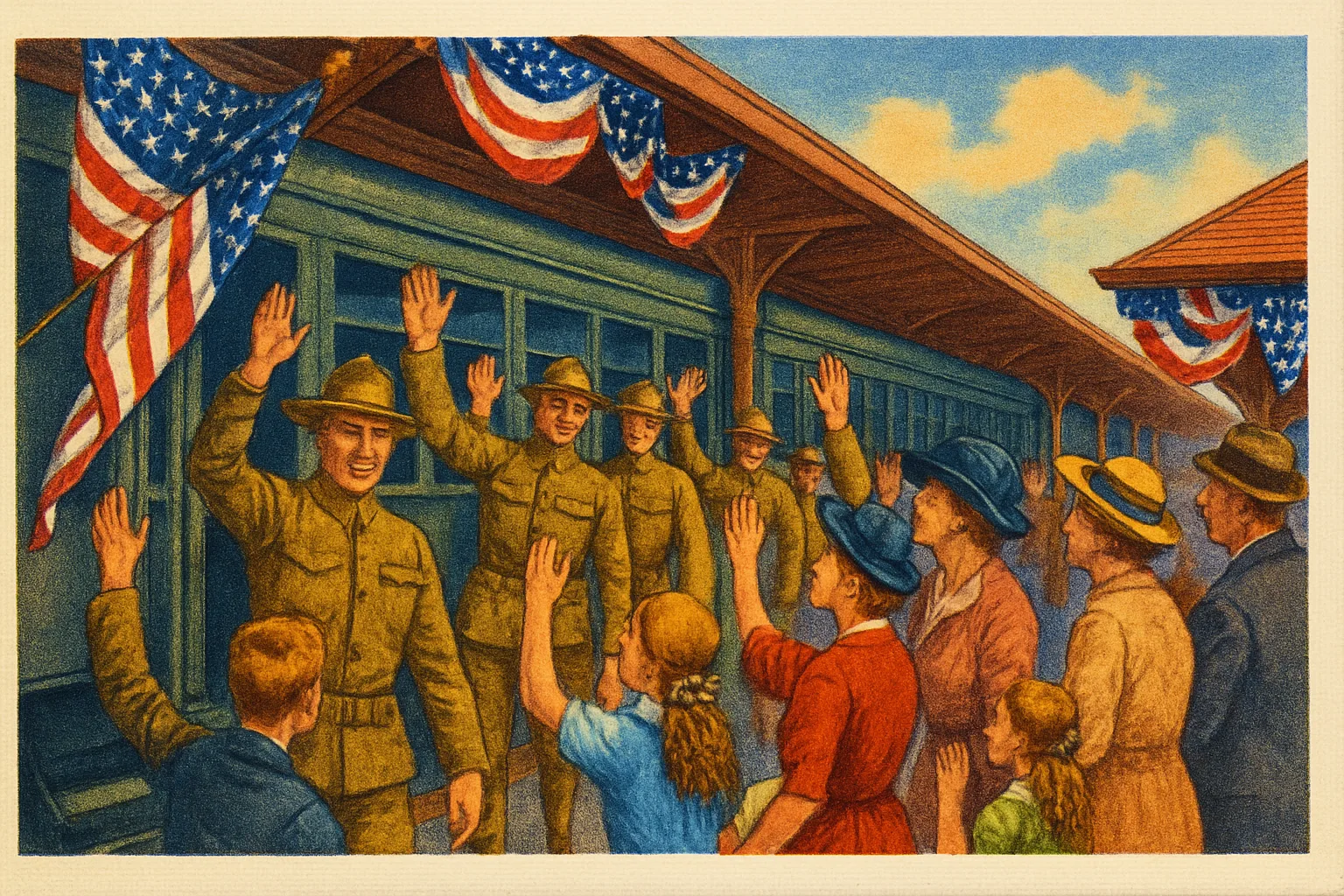
Flags, eagles, Uncle Sam, Lady Liberty, and slogans urging support for the troops all appeared on cards in these years. Many were greeting cards with patriotic themes rather than views. Some carried messages about thrift, Liberty Loans, or conservation of food. They are a direct record of how the country was asked to think about the war at home.
Training camp views
Hundreds of thousands of American men passed through training camps after the United States entered the war, and many of them mailed postcards home. Printed cards and real photo cards showed barracks, mess halls, drill fields, parades and camp streets. Real photo cards of soldiers, sometimes in groups and sometimes in individual portraits made by camp photographers, were sent to families.
These cards are often more interesting for their backs than their fronts. Messages from camp can mention a soldier's unit, his training, his food and his longing for home. For family historians, a card like that can be a priceless document, especially when it can be matched with census and military records. And the real photo postcard guide explains how to date the photographic paper itself.
Military humor and sentiment
There were also comic cards about army life: rookies, cooks, sergeants and kitchen duty. And there were sentimental cards for mothers and sweethearts. These were usually American-printed and fit the white border look of the time.
What changed for good
After the war, German printers returned to the postcard trade, but the American market had moved on. American firms were established, the white border look had become standard for a time, and the postcard craze of the prewar years was not repeated. When the next big change came, in the early 1930s, it was an American innovation: the linen card, printed on textured stock in bright, bold color. Its story belongs to the motor age, and to Curt Teich's Chicago presses.
What collectors look for
If you want to explore this period, a few kinds of cards are especially rewarding:
- Pairs that show the transition. The same town view printed in Germany before the war and in the United States after it. Comparing them makes the change vivid.
- Cards postmarked in the two-cent window, with correct postage, ideally two one-cent stamps.
- Postage-due cards from the transition, which show the rate change catching people out.
- Training camp real photos with informative messages on the back.
- Patriotic greeting cards in good condition with clear designs.
- Cards from short-lived publishers that disappeared when their German suppliers did.
Condition and scarcity matter here as they do everywhere, and the guide on what makes a postcard valuable goes into how they combine. But the real pleasure of this era is historical. A white-bordered card with a two-cent stamp and a message from a training camp holds a tariff fight, a war and a family's worry in one small piece of card.