One of the nice things about old postcards is that a great many of them are inexpensive. Billions were printed and mailed in the early twentieth century, and a large share of what survives is common. That means you can build a satisfying, interesting collection without spending much, and learn a great deal along the way.
This post is about how to start: choosing a focus, finding affordable cards, training your eye to spot the better ones, storing them well without expensive supplies, and keeping simple records. I won't quote prices, because they vary so much by place, seller and moment, but the principles hold whatever your budget.
Why start with a theme
You can collect any old postcard that catches your eye, and plenty of people do. But a theme makes collecting on a budget much easier, for several reasons:
- It keeps spending focused. You'll pass over cards that don't fit, which saves money.
- It builds knowledge quickly. Looking at many cards of one kind teaches you what is common and what isn't.
- It gives the collection shape. A box of cards that tell a story is more satisfying than a random pile.
- It makes searching easier. You know what to look for in a dealer's box or an online listing.
Theme ideas that work well on a budget
Some themes are naturally affordable because the cards are plentiful.
- Your hometown or county. Every town had cards, and building a picture of one place over time is endlessly interesting. Common views of main streets, churches and parks are often easy to find.
- A state. Broad enough to find cards often, narrow enough to give focus.
- A kind of building. Courthouses, libraries, post offices, schools, churches, railroad depots, hotels or lighthouses.
- A kind of place. Parks, lakes, bridges, waterfalls, beaches.
- The highway. Linen cards of tourist courts, gas stations and roadside attractions, which I describe in linen postcards and the motor age.
- A publisher. Collecting cards from a single large publisher, such as Curt Teich, can be both affordable and absorbing, since their numbered series give you a framework.
- An era. White border cards, for example, or linens, each with its own look.
- Messages. Some collectors look for cards with interesting things written on the back, whatever the picture.
Some themes are harder on a budget. Early holiday cards by famous artists, real photo postcards of small-town main streets, and cards of disasters or early aviation tend to attract strong competition. You can still collect them, but it may be slower.
It's fine to change themes later. Many collectors start broadly and narrow down, or start narrowly and branch out.
Where inexpensive cards come from
Common cards
Some cards were printed in enormous numbers: popular tourist sights, big-city landmarks, resort views, scenic chromes from the 1950s onward. They're common because so many survive. These are a fine place to start. They let you handle a lot of old cards, learn the eras, and build the start of a collection quickly.
Lots
Many sellers group cards into lots, often by state, topic or era. Lots tend to be good value per card, and they are a great way to practice sorting and dating. You may find duplicates, a few damaged cards, and a few that don't fit your theme, but you'll learn something from all of them. If a lot includes cards outside your interest, you can trade them with other collectors.
Dealer boxes at postcard shows
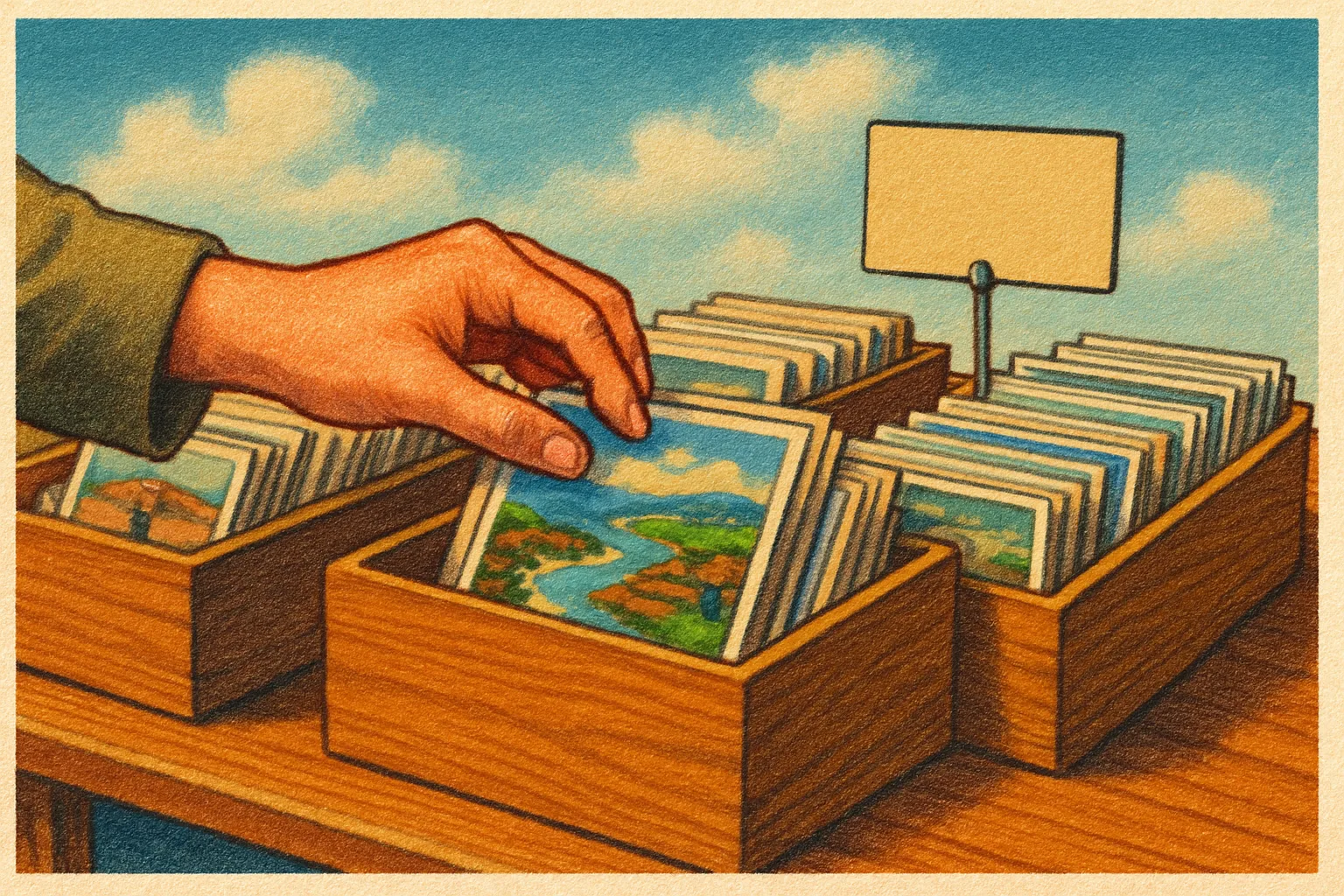
Postcard shows and collectors' club meetings are among the best places to find affordable cards. Dealers usually bring boxes organized by state and town, by topic, or by price range, and many have "bargain boxes" of common cards. Shows let you handle cards before you buy, ask questions and learn from people who have been at it a long time.
A few tips for shows:
- Bring a list of the towns or topics you're looking for, so you can go straight to the right sections.
- Bring a magnifier and a small ruler.
- Take your time. Bargain boxes reward patience.
- Ask dealers questions. Most enjoy talking about cards.
- Set a budget before you arrive, and stick to it.
Online listings
Online marketplaces offer a vast selection, including many inexpensive single cards and lots. Search by town and state together with "postcard," and look at the photos of both sides. If a listing doesn't show the back, ask to see it.
My own cards are listed in my eBay store, organized into single listings and lots. The where to buy page explains how they're set up.
Family, friends and attics
Postcards often turn up in family albums, attic boxes and old scrapbooks. If relatives have cards, ask about them. Even if you don't keep them, they're a good chance to practice reading and dating old cards, and they may connect to your family's history in ways worth exploring. Names, addresses, postmarks and messages can all be checked against census records and city directories.
Learning to spot better cards in common boxes
The real fun of collecting on a budget is finding a better card in a box of common ones. It happens, and it happens more to people who know what to look for.
Look at the back first
Many collectors flip straight to the back. That's where you'll find:
- The postmark. A clear postmark from a small town, a post office that no longer exists, or an unusual date can make a common card more interesting. My guide on how to read a postmark explains what to look for.
- The message. A long, vivid message about local events, a trip, a disaster or daily life can be worth more to a collector than the picture.
- The stamp box. On real photo cards, the paper maker's stamp box helps date the card, as explained in the real photo postcard guide.
- The publisher. Some small local publishers produced cards in small numbers.
Learn to recognize real photos
Real photo postcards are photographs printed directly on postcard paper, and small-town real photos are among the most sought-after cards. Some turn up mixed into common boxes. Look for continuous photographic tone with no printing dots under magnification, a stamp box from a photographic paper maker on the back, and handwritten or scratched-in captions on the front.
Look for small towns and close-up subjects
As a general rule, cards showing small places, ordinary businesses and close-up street scenes are scarcer than cards of famous landmarks. A main street with signs you can read, a depot with a train, a general store interior or a small factory will usually be more interesting, and often scarcer, than another view of a famous building.
Know what condition can and can't do
A clean card is nicer than a worn one, but don't pass over a scarce view just because it has a soft corner. For a budget collector, cards with honest wear can be the best way to own interesting views. The guide on what makes a postcard valuable explains how scarcity, subject, condition and demand combine.
Watch for reproductions
Some cards in bargain boxes are modern reprints of old designs. Check for modern printing patterns under magnification, barcodes or websites on the back, glossy coatings that don't belong, and sizes that don't match early standards. My post on how to spot a reproduction postcard has a full checklist.
Learning to date cards
Dating is the single most useful skill a new collector can learn, and it costs nothing. It lets you sort a mixed box quickly, describe your cards accurately, and understand where each card fits in history.
The basic eras, roughly:
- Private mailing cards, about 1898 to 1901.
- Undivided backs, 1901 to 1907.
- Divided backs, from 1907.
- White borders, about 1915 to 1930.
- Linens, about 1931 to the early 1950s.
- Photochromes or chromes, from 1939 onward.
My guide on how to date an old postcard goes through each one with the clues to look for.
Storage on a budget
Good storage protects your cards and doesn't have to be expensive. The key is avoiding things that cause harm.
What to use
- Archival sleeves. Clear, acid-free, PVC-free sleeves sized for postcards protect cards from handling and dust. Look for polypropylene or polyester.
- A box. A sturdy, acid-free box with dividers holds sleeved cards upright. A clean shoebox will do for a start, though archival boxes are better long-term.
- Dividers. Index cards or cut card stock let you organize by town, topic or era.
What to avoid
- Old "magnetic" photo albums, whose adhesive pages can stain and stick to cards.
- PVC plastic sleeves, which can give off chemicals that damage paper over time.
- Rubber bands and paper clips, which leave marks and dents.
- Tape and glue.
- Attics, basements and sunny windowsills, where heat, damp and light do damage.
My guide on how to store old postcards goes into more detail.
Handling
Handle cards by their edges, with clean, dry hands. Don't try to clean or repair old cards; it's easy to do more harm than good.
Keeping records
Simple records make a collection more useful and more enjoyable. They help you avoid buying duplicates, remember what you know about each card, and share the collection with others.
A simple system
- Give each card a number. A box number and a slot number work well. Write it lightly in pencil on the sleeve, not on the card.
- Keep a list. A notebook or a spreadsheet with columns for the number, town and state, subject, era, publisher, posted or unposted, postmark date, and notes.
- Transcribe messages. Old handwriting is easier to read once, carefully, than many times. Mark uncertain words.
- Note where you got it. The show, the dealer, the lot, and when.
- Scan or photograph both sides, if you can. It preserves the information and lets you share cards without handling them.
That's essentially the method I use for my own cards: each one gets a box and slot number, a scan of both sides, a date range with the evidence behind it, and a transcription of the message. You can read more on my about page.
Joining the community
Postcard collectors are a welcoming lot. Postcard clubs meet in many regions and often hold shows and talks. Online forums and collector groups are full of people happy to help identify a card or read a postmark. Local historical societies often appreciate collectors who share views of their towns.
Being part of that community is one of the best ways to learn, and it often leads to trades, which are the most budget-friendly way of all to grow a collection.
A collection that grows with you
Starting small is not a compromise. A focused collection of common cards, carefully dated, well stored and properly recorded, is a real collection, and it will teach you more than a few expensive cards bought in a hurry. As your knowledge grows, you'll find yourself spotting the interesting cards in the bargain box, reading postmarks at a glance, and knowing exactly which gap in your town or topic you're looking to fill.
Pick a theme, find a box of old cards, and start reading the backs. That's how every collection begins.