For a few years in the early twentieth century, the postcard was the standard way to send holiday greetings. It was cheap to buy, cheap to mail, and quick to write. Millions of Americans sent Christmas and New Year cards to relatives, friends and neighbors, and many of those cards were kept in albums, which is why so many survive.
The best of them are small works of printing art: embossed, richly colored, sometimes gilded, often printed in Germany. They also record a Christmas that looks a little different from the one most people know today, with a Santa Claus who had not yet settled on a single look.
This post covers Christmas postcards from about 1900 to 1920: how they were made, what they showed, who published and designed them, and what collectors look for today.
The holiday postcard boom
Greeting postcards rode the same wave as view cards. After March 1, 1907, when American cards were allowed to carry a message on the left half of the back, the number of postcards in the mail soared. Holiday cards were a big part of that, and Christmas and New Year were the biggest holidays of all.
Holiday cards suited the postcard format. A brief greeting was all most people wanted to send, and a card with a pretty picture said most of it. For a one-cent stamp you could send good wishes across the country.
Santa Claus before the red suit settled
The most striking thing about early Christmas postcards, for many people, is Santa himself.
Many colors of robe
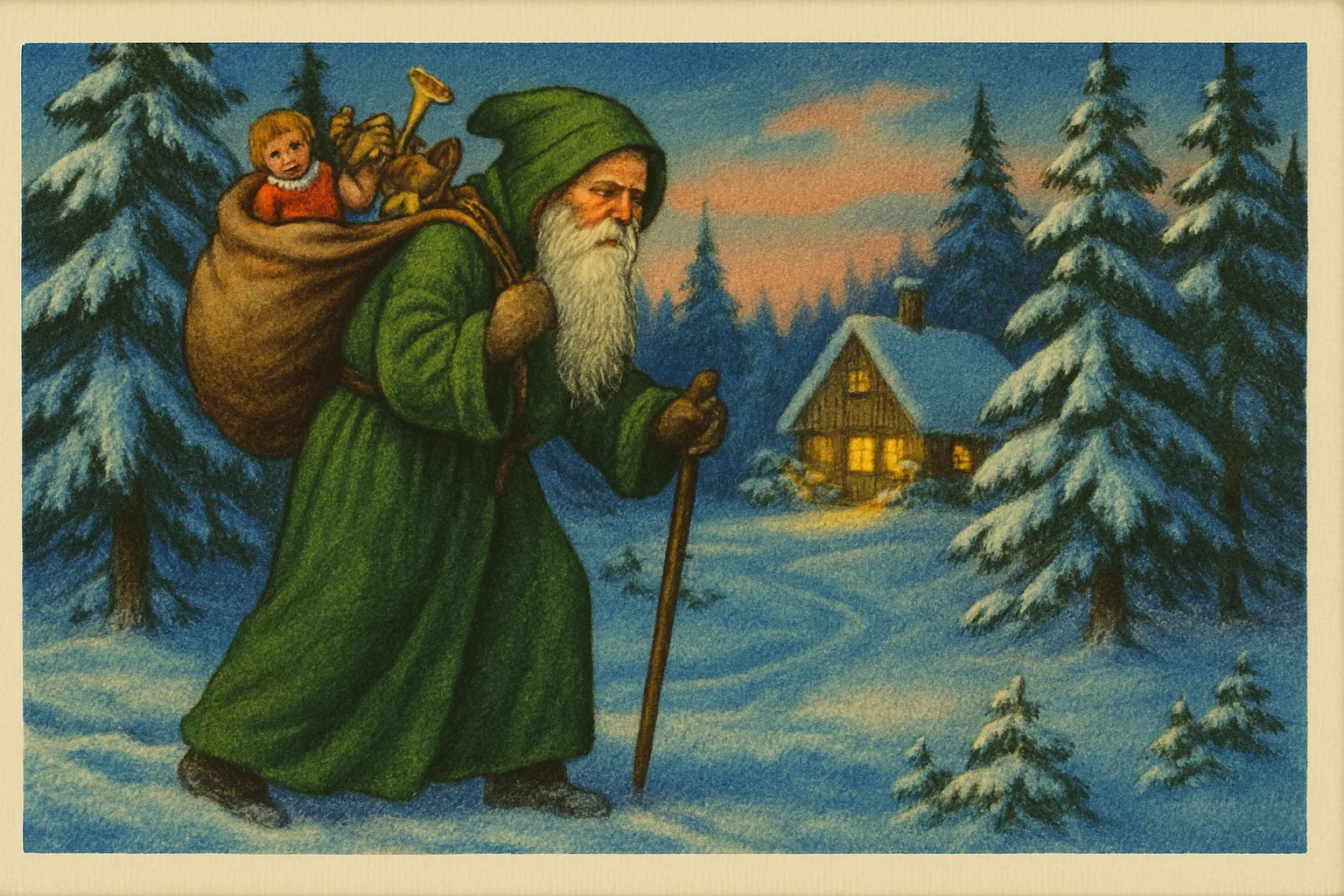
Most people today picture Santa in a red suit with white fur trim, and that image did exist in the early 1900s. But on postcards of the period you will also find Santa in long robes of blue, green, brown, purple, gold and white. Color historians note that Victorian Christmas imagery used many palettes, and Santa's robes followed suit.
The famous Coca-Cola advertisements painted by Haddon Sundblom, beginning in 1931, did a great deal to fix the jolly, red-suited Santa in the public mind. But they did not invent him, and red Santas are common on cards from decades earlier. What the ads did was help settle a figure who, on early postcards, still came in many forms.
Many kinds of Santa
Early cards also show variety in Santa's character:
- The old-world gift bringer. A tall, solemn, long-robed figure with a staff, closer to European traditions of St. Nicholas and Father Christmas. These cards were often printed in Germany and some were sold in several countries.
- The American Santa. Round, cheerful, bearded and fur-trimmed, carrying a sack of toys, influenced by the illustrations Thomas Nast drew for Harper's Weekly in the late nineteenth century.
- The modern Santa. On some cards Santa rides in an automobile, an airship or an early airplane, a sign of how fascinated people were with new technology.
Santa might be shown with a sleigh and reindeer, on a rooftop by a chimney, in a workshop, filling stockings, or walking through snowy woods with a tree on his back. Children, toys, holly, mistletoe and evergreens are everywhere.
Embossed German cards
Many of the finest early Christmas postcards were printed in Germany, which led the world in color lithography before the First World War. I explain how that changed in how World War One changed American postcards.
Typical features of German-printed holiday cards include:
- Embossing. Raised designs, pressed into the card, give Santa's beard, holly leaves and lettering a three-dimensional feel. You can see the reverse of the embossing on the back.
- Rich, layered color from chromolithographic printing, with fine detail and deep shades.
- Gold and silver highlights, sometimes as metallic inks, sometimes applied as gilding.
- Glossy finishes and occasionally glitter, which was applied to some cards.
- An imprint such as "Printed in Germany," "Printed in Saxony" or "Printed in Bavaria."
Some cards went further, with applied materials such as small pieces of fabric, or "hold-to-light" construction, where cutouts let light shine through windows or stars when you hold the card up to a lamp. These are less common than ordinary embossed cards and are especially popular with collectors.
Publishers
Hundreds of firms published holiday postcards, and many cards carry no publisher's name at all. A few names come up again and again.
Raphael Tuck & Sons
Tuck was a London firm with an international reach, and it is credited with doing a great deal to popularize the Christmas card generally. Much of its color printing was done in Germany, and early Tuck cards often carry a line saying they were printed in Bavaria or Saxony. Tuck introduced its "Oilette" series, reproducing paintings on postcards, in 1903, and it published a great many Christmas and New Year designs. Tuck cards are usually clearly marked with the firm's name and an easel-and-palette trademark, and many carry series numbers, which collectors use to identify sets.
John Winsch
John Winsch was a publisher based in Stapleton, on Staten Island, New York. His firm is best known for elaborate holiday cards from about 1910 to 1915, many of them heavily embossed and printed in Germany. Many Winsch designs are attributed to the artist Samuel Schmucker, though Schmucker's work is often unsigned, and some sources date the firm's postcard work a little earlier. Winsch cards are often marked with a copyright line and the firm's name on the back. Some other publishers used similar backs, so attribution needs care.
International Art Publishing Company
This New York firm published a large number of holiday cards, many of them printed in Germany. It is especially associated with the artist Ellen Clapsaddle.
Other names
You will also see cards from many other American and European publishers, some well known and others obscure. When a card has no publisher's mark, the design and printing can sometimes suggest a source, but I would treat any such attribution as a guess unless it is confirmed by a marked example.
Artists
Some of the most collected Christmas cards are signed by their artists. The artist-signed postcards guide explains how signatures appear and why they matter.
Ellen Clapsaddle
Ellen Clapsaddle (1865 to 1934) was born in South Columbia, Herkimer County, New York. She worked mainly for the International Art Publishing Company and became its leading illustrator, and she is credited with more than 3,000 postcard designs, more than half of them showing children. She spent time in Germany working with the engravers who printed her designs. Her Christmas cards, with rosy-cheeked children, Santas, holly and snow scenes, are among the most familiar of the period. Her signature, usually "Ellen H. Clapsaddle" or a shorter form, appears on many of them, though not all of her work is signed.
The First World War hit her hard. The firms that depended on German printing were cut off, and much of her original artwork is believed to have been lost.
Samuel Schmucker
Schmucker is associated with many of the most elaborate Winsch holiday cards, including Christmas designs. Because so much of his work is unsigned, collectors usually rely on the Winsch name and the style of the design, and dealers' attributions vary.
New Year cards
Early postcard collectors often notice that New Year cards are almost as common as Christmas cards, and in some collections they seem more common. Sending good wishes for the New Year was a strong tradition, and many cards combine both holidays with greetings like "A Merry Christmas and a Happy New Year."
New Year cards have their own imagery:
- Father Time and the New Year baby, sometimes shown handing over the year.
- Bells, ringing in the year.
- Horseshoes, four-leaf clovers and other good luck symbols.
- Calendars and clocks with the year printed on them.
- Snowy village scenes and winter landscapes.
Cards with a printed year, such as "1910," are handy for dating. Remember, though, that a card with a printed year might have been mailed late, or saved for the next year with the date crossed out.
Reading the backs
Christmas cards were mailed in late December, so the postmark is often less surprising than on a view card. Even so, the back is worth reading:
- The postmark confirms the year, and its town tells you where the sender was. My guide on how to read a postmark covers what to look for.
- The stamp is often a one-cent green Franklin, paying the standard domestic rate of the time. During the brief two-cent period of November 1917 to July 1919, you may see two cents in postage.
- The publisher's mark and series number help identify the card.
- The message is usually short, but sometimes includes family news, which can help a family historian.
Dating Christmas postcards
The same methods used for view cards apply to holiday cards:
- Back design. An undivided back usually means before 1907; a divided back usually means 1907 or later.
- Imprint. "Printed in Germany" points to before the First World War, while American-printed cards became more common during and after it.
- Printed year, on New Year cards.
- Postmark, if the card was mailed.
- Style. White borders and flatter printing suggest the later 1910s and 1920s.
My guide on how to date an old postcard covers each of these in detail.
What collectors look for
Christmas collectors have many specialties, and there is no single list of desirable cards. But some features come up again and again:
- Santa in unusual colors. Blue, green, purple and brown robed Santas attract interest.
- Santa with new technology. Cars, airships, airplanes and telephones.
- Fine embossing and gold. Strong, unworn embossing and bright gilding.
- Hold-to-light and applied materials. Less common construction.
- Signed artists, especially Clapsaddle and other well-known names.
- Marked publishers, such as Tuck and Winsch, particularly identified series.
- Condition. Holiday cards were often kept in albums, so clean, bright examples survive; corner wear, creases and album marks reduce appeal.
The guide on what makes a postcard valuable explains how scarcity, condition and demand combine.
A word about reproductions
Early Christmas images are widely reprinted for decorating and crafts, and some of those reprints end up mixed with originals. A flat card showing printed "shadows" of embossing, a crisp modern dot pattern under magnification, or a glossy coating that doesn't belong are all warning signs. My post on how to spot a reproduction postcard walks through the checks I use.
Caring for holiday cards
Embossed cards can flatten if pressed hard, and glitter and gilding can flake. Store them upright in archival sleeves, with enough room that they aren't squeezed, and away from light and damp. My guide on how to store old postcards has more detail.
A Christmas from another century
What I enjoy most about early Christmas postcards is the sense of looking at a familiar holiday through slightly different eyes. The holly and the snow are the same, and so is the wish for a merry Christmas. But Santa wears green, rides in an open car, or walks through a German forest with a lantern, and the greetings are written in a looping hand by people who expected their card to be kept. Many of them were, and they turned up again, more than a century later, still bright.